
Infrastructure
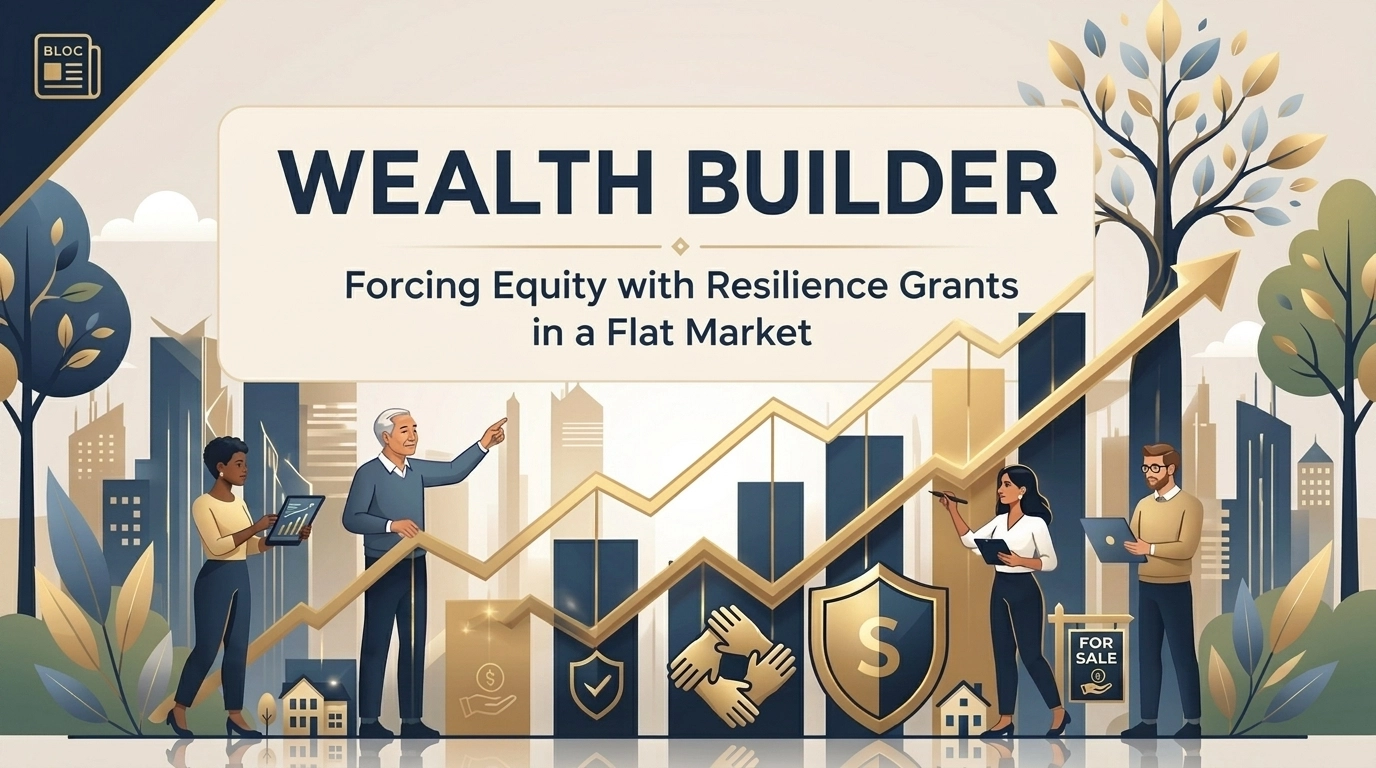
Wealth Builder: Forcing Equity with Resilience Grants in a Flat Market
Let’s be real for a second: the real estate market isn't always a rocket ship heading for the moon. Sometimes, it’s more like a flat plateau where prices just... sit there. If you bought property a few years ago expecting a massive equity spike, a flat market can feel like you’re spinning your wheels.
But here is the "Wealth Builder" secret: you don't have to wait for the market to give you equity. You can go out and grab it yourself.
In the real estate world, we call this forcing equity. Usually, that means swinging a hammer or writing a big check for a kitchen remodel. But right now, there is a massive opportunity to force equity using someone else’s money: specifically, the $211M "Rebuilding for Tomorrow" resilience grant fund.
If you own property that’s been dinged by storms or is sitting in a high-risk zone, this is your playbook for turning a potential liability into a high-yield wealth engine.
What Does "Forcing Equity" Actually Mean?
Before we dive into the grants, let’s clear up the jargon. Most people rely on market appreciation. That’s when you buy a house for $400k, do nothing, and five years later it’s worth $500k because the neighborhood got popular. That’s passive wealth.
Forced equity is active. It’s when you make a specific improvement that increases the property value by more than the cost of the improvement. If you spend $20k on a smart renovation and the home value jumps by $40k, you’ve "forced" $20k of equity into existence.
In a flat market, forced equity is the only way to build significant wealth quickly. And when you use grant money to do it? Your ROI (Return on Investment) effectively becomes infinite because you aren’t using your own capital.
!Forcing equity by installing modern impact windows using Rebuilding for Tomorrow resilience grants.

The $211M Opportunity: Rebuilding for Tomorrow
Living in coastal or storm-prone areas comes with a "weather tax": higher insurance premiums and the constant threat of damage. However, the $211M "Rebuilding for Tomorrow" initiative is designed to flip that script.
These funds are earmarked for strategic resilience upgrades. We’re talking about: Impact-resistant windows and doors. Roof reinforcements (straps, clips, and secondary water barriers). Elevation projects for flood-prone areas. Hardening the "envelope" of the building to withstand high winds.
When you use these funds to upgrade a storm-damaged or vulnerable property, you aren’t just "fixing" a house. You are future-proofing an asset. You are lowering the future owner’s insurance costs and increasing the appraisal value because the home is now "Gold Fortified" or the local equivalent.
The Urban Apartment Advantage
While single-family homes get a lot of the spotlight, the real wealth-building play right now is in urban apartments.
Urban centers remain the heartbeat of the economy, but many of these buildings are aging and vulnerable. Using resilience grants to upgrade a multi-unit property does two things: 1. Protects Your Cash Flow: A storm that knocks out a building for six months kills your rental income. A resilient building stays online. 2. Compression of Cap Rates: When you lower the operating expenses (like insurance and maintenance) through resilience upgrades, the "value" of the building goes up significantly for the next investor.
If you own an urban apartment or are looking to buy one, targeting properties that qualify for "Rebuilding for Tomorrow" funds is like finding a value-add property where the most expensive upgrades are subsidized.

The "Accidental Landlord" Pivot
Sometimes, the market is so flat that selling your property right now doesn't make sense. Maybe you’d barely break even after commissions, or maybe you don't want to trade your 3% mortgage for a 7% one.
This is where the "Accidental Landlord" pivot comes in. Instead of forcing a sale in a lukewarm market, you pivot to a holding strategy.
By utilizing resilience grants now, you can: Renovate for Free (or Cheap): Use the grant money to handle the big-ticket structural items. Increase Rentability: High-quality, storm-proof windows don't just protect against hurricanes; they block street noise and lower utility bills: huge selling points for tenants. * Wait for the Cycle: Real estate moves in cycles. By holding the property as a rental, you let a tenant pay down your mortgage while you wait for the market to heat up again.
When the market finally does turn (and it always does), you won’t just be selling a standard house; you’ll be selling a high-efficiency, storm-resilient "Wealth Builder" asset that commands a premium.
Strategic Equity Preservation
We often talk about building wealth, but we don't talk enough about preserving it. Strategic Equity Preservation is about making sure your equity doesn't get eaten away by "death by a thousand cuts": soaring insurance premiums, emergency repairs, and high vacancy rates.
In 2026, the biggest threat to your real estate equity isn't just a market crash; it’s the cost of carrying the asset. If your insurance doubles, your cash flow dies. By proactively seeking out grants like "Rebuilding for Tomorrow," you are putting a shield around your equity. You are making your property the "safest bet" in the neighborhood.

How to Get Started
If you’re sitting on a property that needs work, or if you’re looking to acquire a "fixer-upper" with a resilience twist, here’s your move:
1. Audit Your Property: Check for storm damage or aging structural elements (roof, windows, etc.). 2. Check Eligibility: Look into the "Rebuilding for Tomorrow" requirements. These funds are often distributed through local municipalities or specific state programs. 3. Run the Numbers: Calculate what the property would be worth after the upgrades. Don't just look at the sales price: look at the insurance savings. 4. Consult an Expert: This isn't just about finding a house; it's about finding a strategic asset.
At Jonathan Loescher brokered by Realty of America, we specialize in identifying these types of "hidden" opportunities. Whether you are trying to navigate a flat market or looking to pivot into a rental strategy, we can help you find the path that leads to long-term wealth.
Final Thoughts
A flat market isn't a "wait and see" market: it’s a "do and build" market. While everyone else is complaining about stagnant prices, the savvy investors are using resilience grants to force equity into their portfolios. They are turning "accidental" situations into intentional wealth.
Don't let your equity sit idle. Let’s figure out how to harden your assets and grow your net worth, regardless of what the broader market is doing.
Ready to talk strategy? Reach out to us here or check out more wealth-building tips on our blog.

Have a question about how this applies to your home or loan?
Book a Call