

Wealth Building
Wealth Builder: Navigating the 2026 "Save Our Homes" Property Tax Reset
Title: Wealth Builder: Navigating the 2026 "Save Our Homes" Property Tax Reset Slug: wealth-builder-florida-property-tax-reset-trap Excerpt: One of the biggest hidden costs for new Florida investors is the property tax reset. Learn how the Save Our Homes cap works and how to estimate your real ROI. Meta title: Wealth Builder: Florida Property Tax Reset & ROI (48 chars) Meta description: Don't let the property tax reset ruin your investment. Learn how the Save Our Homes cap affects new buyers in Pinellas and Pasco in 2026. (146 chars) Meta keywords: Save Our Homes Florida, property tax reset, real estate ROI calculation, Tampa investment property, Jonathan Loescher
It’s April 2026, and if you’ve been following the Florida real estate market lately, you know things are moving fast. Between the legislative sessions in Tallahassee and the shifting inventory in Pinellas and Pasco counties, there is a lot to keep track of.
I’m Jonathan Loescher, and today I want to talk about something that can either make or break your investment strategy this year: the "Save Our Homes" (SOH) property tax reset.
Whether you’re looking at a beachfront condo in Tierra Verde or a family home in Belleair Beach, understanding how Florida taxes work is the difference between a profitable portfolio and a cash-flow nightmare.
The "Save Our Homes" Safety Net (And the Trap)
In Florida, we have a fantastic benefit for homeowners called the "Save Our Homes" assessment limitation. Essentially, once you qualify for a homestead exemption, the assessed value of your property cannot increase by more than 3% per year (or the percent change in the Consumer Price Index, whichever is lower).
For someone who has owned their home for 15 or 20 years, this is a massive win. Their home might be worth $1 million on the open market, but they are only paying taxes on an assessed value of $400,000.
Here is where the trap lies for you, the buyer.
The moment that property sells, the "Save Our Homes" protection vanishes. The tax clock resets. The property appraiser looks at what you just paid for the home and adjusts the assessed value to match the current market value.
If you are looking at the current owner’s tax bill to estimate your future holding costs, you are making a massive mistake.

Why Zillow’s Tax History is a Lie for Investors
I see it every day. An investor finds a great property on a search site, looks at the "Tax History" section, and sees that the previous owner paid $2,400 in taxes last year. They plug that $200/month into their ROI calculator and think they’ve found a "unicorn" with 8% cash-on-cash returns.
Then, year two of ownership hits.
The property appraiser catches up with the sale price. Because the previous owner was homesteaded for a decade, the "Save Our Homes" cap was keeping those taxes artificially low. Now that you own it: especially if it’s an investment property: that $2,400 bill can easily jump to $6,000 or $8,000.
Suddenly, your "profitable" investment is bleeding cash.
For 2026, this is more relevant than ever. As we wait for the special legislative session starting April 20th, we are seeing market values in the Tampa Bay area remain resilient. When the reset happens, it hits hard.
2026 Legislative Shifts: What You Need to Know
We are currently in a very interesting window for Florida property taxes. As of this month, April 2026, several major bills are moving through the Florida House and Senate that could change the math for you.
1. HJR 203 (Non-School Tax Elimination): There is a major push to eliminate non-school property taxes. If this passes and is approved by voters in November, it could cut total tax bills significantly starting in 2027. This would be a game-changer for wealth builders. 2. SJR 278 (New Buyer Protection): This is specifically designed to address the "tax shock" I mentioned earlier. Lawmakers are looking at ways to limit the massive spike in taxes that happens in the first year after a purchase. 3. Portability Expansion (HJR 211): Currently, if you move from one Florida homestead to another, you can "port" up to $500,000 of your SOH tax savings. There is a proposal on the table to uncap this benefit for non-school taxes, making it even easier to upgrade your primary residence without a tax penalty.
While these changes are promising, you have to build your 2026 strategy based on the laws as they stand today.
!Stylized Florida Capitol building representing 2026 property tax legislation and real estate laws.

How to Calculate Your Real ROI
If you’re serious about building wealth through real estate, you need to stop guessing. Here is the "Jonathan Loescher" method for estimating your year-two taxes:
1. Determine the Likely Assessed Value In Pinellas and Pasco, the property appraiser usually sets the assessed value at about 85% to 90% of the purchase price. If you buy a house for $500,000, expect an assessment around $425,000 - $450,000.
2. Check the Millage Rate The millage rate is the amount per $1,000 of property value used to calculate taxes. Each municipality is different. A home in St. Petersburg will have a different millage rate than one in unincorporated Pasco County. You can find these on the County Property Appraiser websites.
3. Account for the Homestead Exemption (If Applicable) If this is your primary residence, you get a $50,000 exemption (split between school and non-school taxes). If it’s an investment property, you get $0.
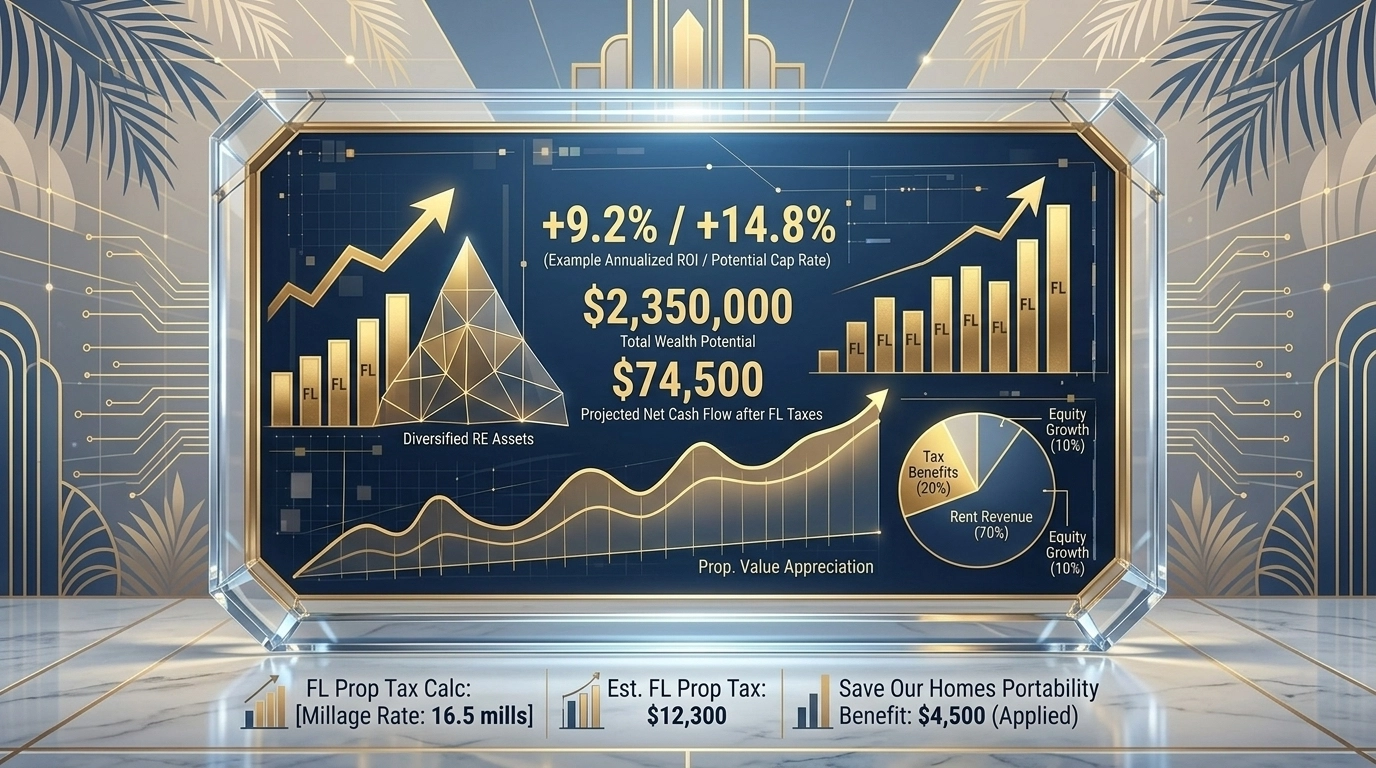
4. The Formula (Market Value x 0.90) - Exemptions / 1,000 x Millage Rate = Your Estimated Tax Bill.
Using this formula will give you a much grittier, realistic look at your cash flow than anything you’ll find on a public listing site.
The 10% Cap for Non-Homestead Properties
If you are buying an investment property that will not be your primary residence, you don’t get the 3% "Save Our Homes" cap. However, Florida does provide a 10% cap on non-homestead properties for non-school taxes.
This is still a great benefit, but it doesn't kick in until the year after the first assessment at market value. This means you still face that initial "reset" to market value in your first full year of ownership. You have to be prepared to weather that jump in your expenses.
Strategies for 2026 Wealth Building
So, how do you navigate this as a buyer right now?
First, consider Portability. If you are selling a home in Florida to buy a new one, make sure you are maximizing your portability benefit. This can save you thousands of dollars a year. If you aren't sure how to calculate your portability transfer, reach out to us at Jonathan Loescher brokered by Realty of America.
Second, look for Millage Rate Adjustments. Some areas in our region are seeing millage rate decreases to offset the rising property values. Buying in a municipality with a lower millage rate can significantly boost your long-term ROI.
Third, stay informed on the November 2026 Ballot. The legislation currently being debated in Tallahassee will likely end up on your ballot this fall. These changes could drastically reduce the tax burden for property owners across the state.
Why Expert Guidance Matters
Real estate is more than just finding a house with a "For Sale" sign. It’s about understanding the underlying financial structure of the state you live in. Florida’s tax system is unique, and while it is very "pro-owner," it can be "pro-surprises" if you don’t have someone in your corner who knows the numbers.
At Jonathan Loescher brokered by Realty of America, we don't just show you houses; we help you build wealth. That means looking at the tax implications, the insurance landscape (another big topic for 2026!), and the long-term appreciation potential of every neighborhood from Tierra Verde to the heart of Tampa.

Final Thoughts
Don't let the "Save Our Homes" reset catch you off guard. If you’re planning a move or an investment this year, let's sit down and run the numbers. We can look at your trade-in options or start a fresh property search with your real tax-adjusted budget in mind.
Florida is still one of the best places in the country to own real estate, but the "smart money" is the money that prepares for the year-two tax bill.
If you want to stay updated on the upcoming special legislative session and how it will impact your property taxes, keep an eye on our blog. I’ll be breaking down the results of those negotiations as soon as they happen.
Build wealth, stay informed, and let's make 2026 your best year in real estate yet.
---
Have a question about how this applies to your home or loan?
Book a Call