
Mortgage Guide
Equity-Based Loans in Florida When Credit Is Thin
Substantial equity in a Florida home can change how a mortgage file is reviewed, but it is not a credit-repair product. Equity does not erase a credit event, it does not replace a repayment review, and it is not a way to "fix" a credit report. There may be a path that weighs the property and the equity more heavily, but not for every file, and I can't promise an approval from this article.
This guide stays on that equity-first question. It is not a general definition of Non-QM, and it is not a retelling of the home equity line article. For those, start with what a non-QM loan is, the first-lien home equity line guide, and the short first-lien HELOC FAQ. For the broader menu, see which loan path fits.
What "thin credit" means here, and what it does not
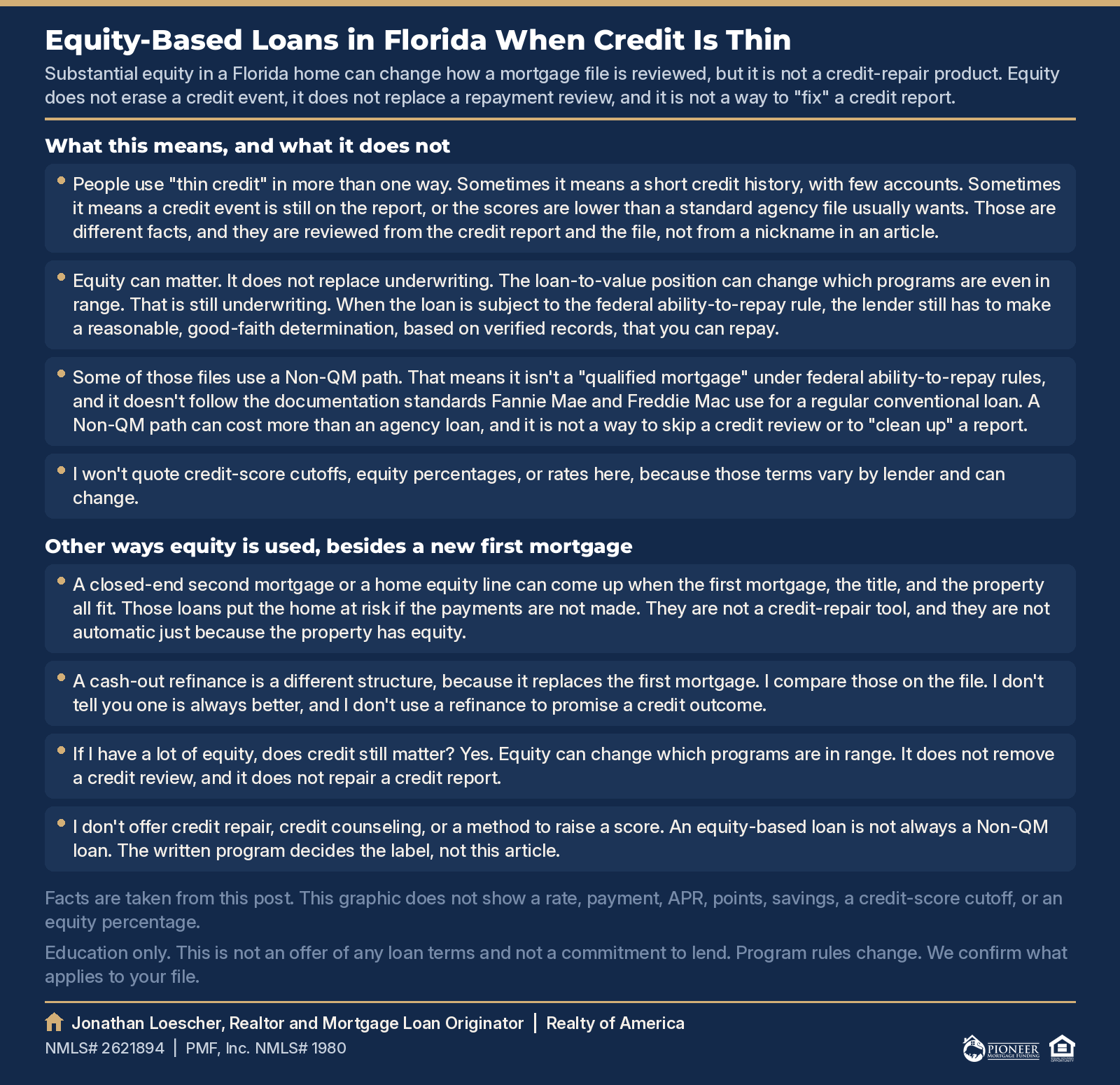
People use "thin credit" in more than one way. Sometimes it means a short credit history, with few accounts. Sometimes it means a credit event is still on the report, or the scores are lower than a standard agency file usually wants. Those are different facts, and they are reviewed from the credit report and the explanations in the file, not from a nickname in an article.
I'm not offering credit repair, credit counseling, or a method to raise a score. I also won't use this page to target people based on a credit problem. The honest question is whether a written loan program can underwrite the file in front of us, including the credit, the equity, the income or asset documentation, and the property.
Equity can matter. It does not replace underwriting.
If you already own a home, or you are buying one with a sizable down payment, the loan-to-value position can change which programs are even in range. Some agency files simply won't fit, and a different program may be willing to look at the equity, the reserves, and the rest of the documentation more closely. That is still underwriting. The lender still has to make a reasonable, good-faith determination, based on verified records, that you can repay, when the loan is subject to the federal ability-to-repay rule.
Some of those files use a Non-QM mortgage. A Non-QM mortgage isn't a "qualified mortgage" under federal ability-to-repay rules, and it doesn't follow the documentation standards Fannie Mae and Freddie Mac use for a regular conventional loan. A Non-QM path can cost more than an agency loan, and it is not a way to skip a credit review or to "clean up" a report. I won't quote credit-score cutoffs, equity percentages, or rates here, because those terms vary by lender and can change.
Other ways equity is used, besides a new first mortgage
If the goal is to use equity in a home you already own, a closed-end second mortgage or a home equity line can come up, when the first mortgage, the title, and the property all fit. Those loans put the home at risk if the payments are not made. They also have their own credit, equity, and documentation rules. They are not a credit-repair tool, and they are not automatic just because the property has equity.
A cash-out refinance is a different structure, because it replaces the first mortgage. Whether that is more or less realistic than a second lien depends on the current first mortgage, the prepayment picture, and the new loan's rules. I compare those on the file. I don't tell you one is always better, and I don't use a refinance to promise a credit outcome.
How I can help
I start with the credit report, the equity, and the property, then with whether an agency path still fits or whether a Non-QM or a second-lien path is the more accurate review. I can originate loans through PMF, Inc. Availability, requirements, and terms vary by lender and property, and I can't promise an approval. I'll tell you early whether I can place the file, and which path that would be.
As a Realtor with Realty of America, I can help you with a purchase or a sale. As a Mortgage Loan Originator with PMF, Inc., I can help with the loan. PMF, Inc. is a mortgage broker that works with many wholesale lenders, so I can compare options for your situation. Rates and terms vary by lender, program and borrower, and I can't promise any particular rate or approval. You can use one or both. You don't have to use both.
Apply for a mortgage or book a consultation. Any loan approval is conditional until all underwriting conditions are met.
Common questions
If I have a lot of equity, does credit still matter?
Yes. Equity can change which programs are in range. It does not remove a credit review, and it does not repair a credit report.
Can you fix or raise my credit score so I can get a loan?
No. I don't offer credit repair, and this article is not a credit-repair service. I review the credit that is actually on the file and compare loan paths that may fit that file.
Is an equity-based loan the same thing as a Non-QM loan?
Not always. Some equity-first files are Non-QM. Others use a second mortgage or a home equity line, or, when the credit and the rest of the file already fit, a regular agency path. The written program decides the label, not this article.
This article is for education only. It is not an offer of any loan terms and not a commitment to lend. Program rules change. We confirm what applies to your file.
Jonathan Loescher, Realtor, Florida real estate license SL3546365, Realty of America. Jonathan Loescher, Mortgage Loan Originator, NMLS 2621894. Mortgage loans are originated through PMF, Inc., NMLS 1980, a Florida licensed Mortgage Broker. Real estate and mortgage services are provided by separate companies, and you don't have to use both. Verify licensing at www.nmlsconsumeraccess.org. Equal Housing Opportunity.
Education only. This is not a commitment to lend. All loans are subject to credit approval, underwriting, and property eligibility. Not all applicants will qualify. Any loan approval is conditional until all underwriting conditions are met. Programs, rates, terms and conditions may change without notice.
Common questions
- What is the average mortgage rate in Florida today?
- I don't post averages here. Rates move often, and your rate depends on your credit, loan program, down payment, property type, occupancy, and lock period. A published average can be far from what you'd get. Ask for a quote on your own scenario, dated, with the program and terms. Any loan approval is conditional until all underwriting conditions are met.
- How often do mortgage rates change?
- Often. Pricing can change daily, sometimes more than once, as bond markets move. Your quote also changes if your credit, down payment, program, or property changes. That's why quotes are dated. A rate lock holds pricing for a set period once you're under contract. Any loan approval is conditional until all underwriting conditions are met.
- What is a rate lock?
- A rate lock holds your rate and pricing for a set number of days while your loan closes. If the market rises, your lock holds. If closing slips past it, an extension may cost extra. Longer locks can cost more. Changes to your file, like the price or credit, can reprice it. Any loan approval is conditional until all underwriting conditions are met.
- What is the difference between pre-approval and pre-qualification?
- Pre-qualification is a conversation about income and credit. Pre-approval is a lender review of a file. Apply on this site for a second look even if you already have a letter from somewhere else.
- What Florida mortgage loan programs can a Mortgage Loan Originator offer?
- Common programs include conventional, FHA, VA, cash-out refinance, and non-QM loans like bank statement and DSCR. Some pair with down payment assistance. The right one depends on your file. You don't have to use both companies. Any loan approval is conditional until all underwriting conditions are met.
More Tampa Bay home and loan answers on Ask Jonathan.
Enjoying this? Make us a preferred source on Google.