
Market Analysis
Three Housing Questions I Keep Hearing in Tampa Bay
I keep hearing the same three questions this fall, and they come up even more around the holidays. Are prices going to crash? Is this 2008 again? And is a recession coming?
Those are fair questions. There's a lot of noise out there, and the national story isn't always the Tampa Bay story. Here's how I walk through each one, using the data, not just the headlines.
Are home prices going to crash?
A national crash is a fast, deep drop in prices, usually with a wave of forced sales. That's not what the 2027 forecasts I could verify show.
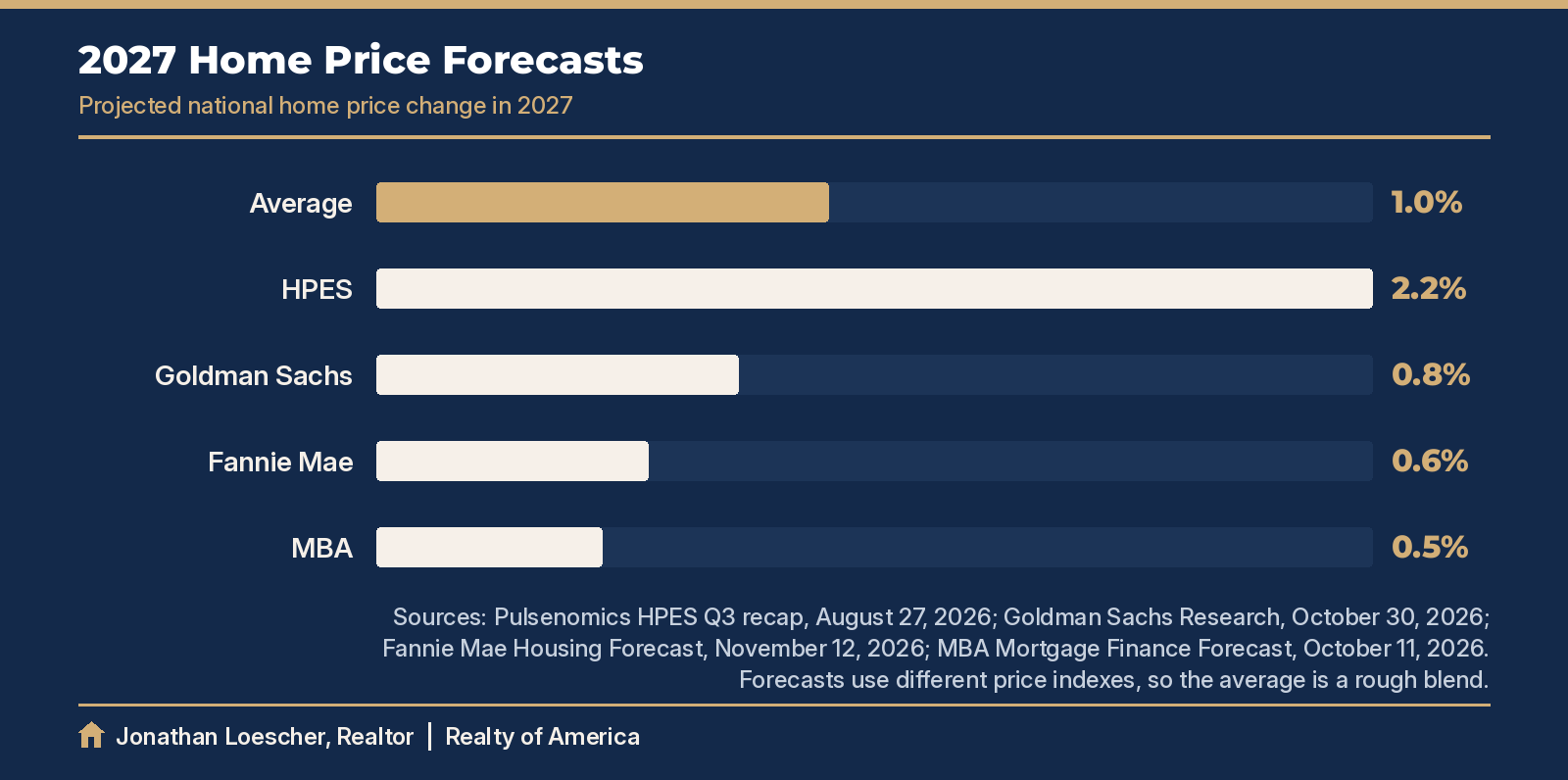
Four published 2027 forecasts, checked at their primary pages, all point to modest national growth:
- The Pulsenomics Home Price Expectations Survey's August 27, 2026 third-quarter recap puts the average 2027 gain at 2.2% on the Fannie Mae Home Price Index.
- Goldman Sachs Research, in an October 30, 2026 article, forecasts 0.8% December-over-December growth in 2027.
- Fannie Mae's November 12, 2026 housing forecast shows 0.6% for 2027, fourth quarter over fourth quarter, on its Home Price Index.
- The MBA, a mortgage trade group, forecast 0.5% for 2027 on the FHFA Purchase-Only House Price Index on October 11, 2026.
A simple average of those four is about 1.0%. Some compilations list a 2.0% NAR figure for 2027, but I couldn't find that NAR forecast. In October 2026, NAR chief economist Lawrence Yun expected 2026 prices to rise about 2% and called it too early to forecast 2027. These forecasts also use different price indexes, so any average is only a rough blend. What they share is slow national growth, not a crash.
These are forecasts, not a promise about 2027, and they are national. They are not a readout of Pinellas or Hillsborough.
Florida also needs an honest look. In a November 6, 2025 NAR report, Yun said, "Price declines are occurring mainly in southern states, where there has been robust new home construction in recent years. Given the region's faster job growth, these price drops should be viewed as temporary and as a second-chance opportunity for those previously priced out of the market."
Tampa Bay is in that southern group, so I won't brush it off. The comment is a year old, and I wouldn't treat it as a promise about your street. In St. Pete, Clearwater, Brandon, and South Tampa, pricing is sensitive to how many similar homes are for sale, and to condition, roof age, flood history, and insurance costs. Two houses a mile apart can tell different stories.
I wrote a longer local read on whether Tampa Bay is headed for a housing crash, and a separate post on why home price headlines conflict. If you're trying to make sense of the numbers you see, start there.
Is this 2008 again?
Foreclosure filings have been rising, and I'll say that plainly. But they've been rising from very low levels.
ATTOM's August 2026 U.S. Foreclosure Market Report, published September 17, 2026, counted 40,277 U.S. properties with a foreclosure filing that month, up 13% from a year earlier. Even with that increase, ATTOM said overall foreclosure activity remains below pre-pandemic norms.
Florida has not been at the quiet end of that data. In ATTOM's mid-year 2026 report, published July 16, 2026, Florida had the highest state foreclosure rate in the first half of the year, at 0.27% of housing units. In the August report, Florida still ranked among the highest-rate states. That's worth taking seriously. It still isn't the 2008 picture.
Logan Mohtashami, lead analyst at HousingWire, put the difference this way in an August 14, 2026 article: "we have had many recessions post-WWII but only one foreclosure crisis. That foreclosure crisis started with a massive credit boom from 2002-2005, and then a credit bust." He added that "none of that is happening now," and that the New York Fed foreclosure series was still below 2019 levels as of that article.
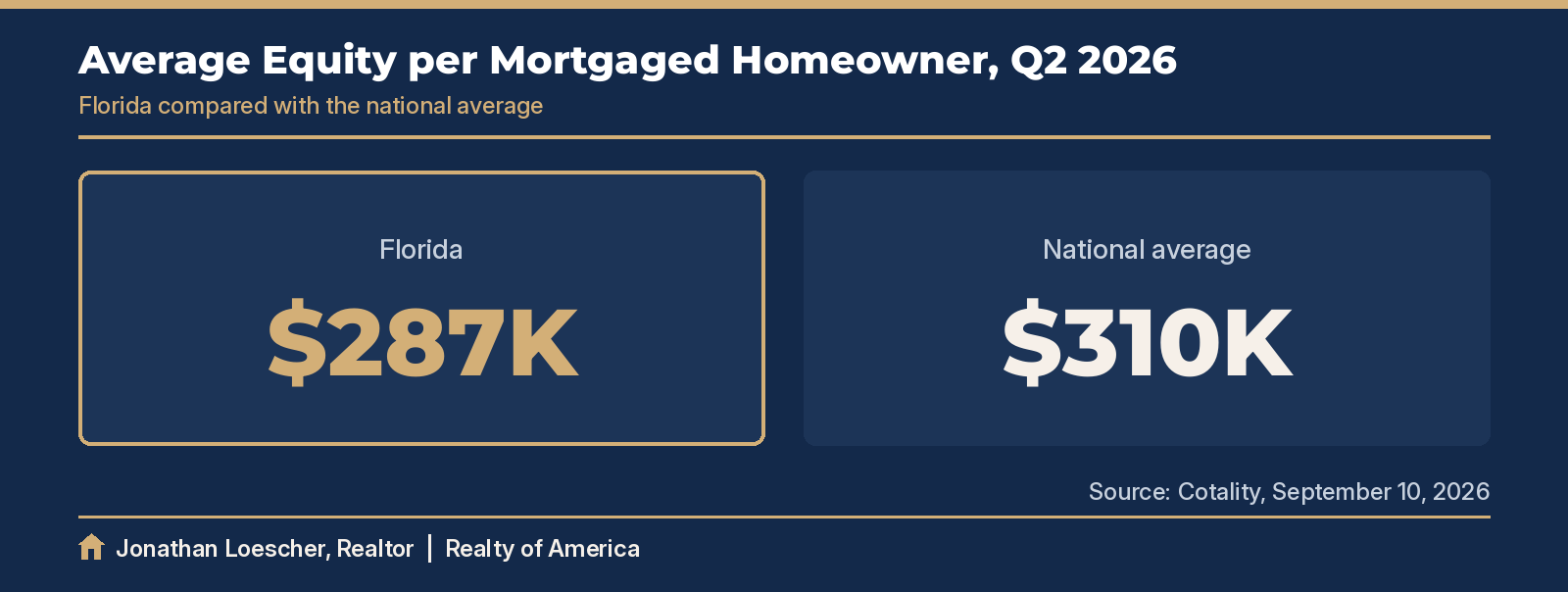
Today's homeowners also hold a lot more equity than many people did then. Cotality's Homeowner Equity Insights Report, published September 10, 2026, found that the average U.S. homeowner with a mortgage had $310,000 of equity in the second quarter of 2026. On Cotality's state map of that same report, Florida's average was $287,000. That's below the national average, but it's still a large cushion compared with the years when millions of owners were underwater.
Equity doesn't make a hardship disappear. It can give a homeowner a way to sell rather than go through foreclosure. That isn't a promise on any one house, but it's one reason this period doesn't look like 2008.
Is a recession coming?
I don't know, and I won't pretend to. What I can show you is what one widely watched survey of economists has been saying, and what happened to home prices in past recessions.
The Wall Street Journal's October 2026 survey of economists, conducted October 2 through October 7 and published October 11, 2026, put the average chance of a U.S. recession in the next 12 months at about 24%. Individual estimates ranged from 1% to 80%. I could not open the Journal's own survey tables without a subscription, so those figures come from secondary coverage of the survey.
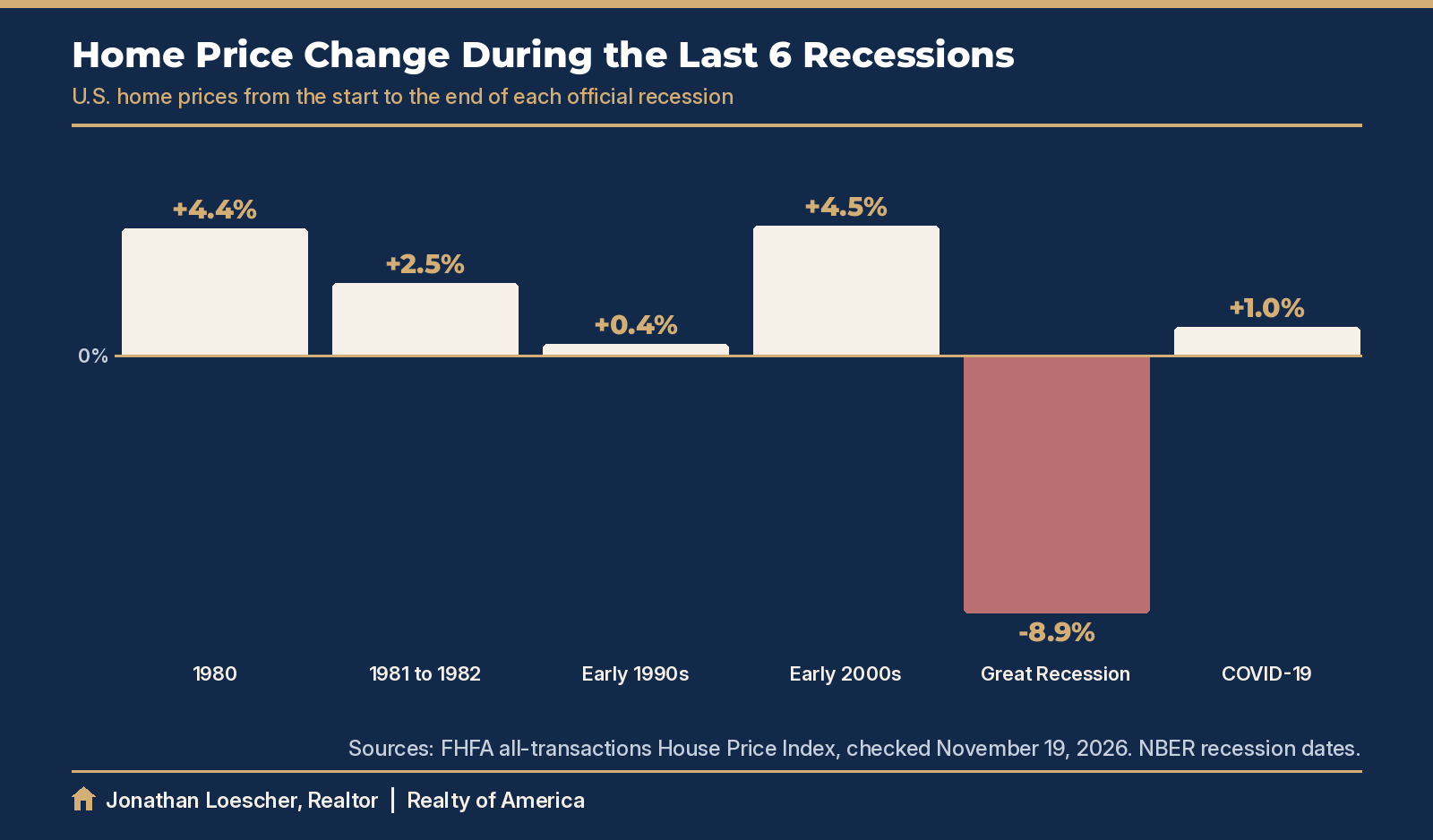
Even if a recession does arrive, history doesn't say home prices automatically fall. I checked the FHFA all-transactions House Price Index for the United States against official recession dates from the National Bureau of Economic Research. Measuring from the quarter a recession began to the quarter it ended, national prices rose in five of the last six recessions:
- 1980: up 4.4%
- 1981 to 1982: up 2.5%
- Early 1990s: up 0.4%
- Early 2000s: up 4.5%
- Great Recession: down 8.9%
- COVID-19: up 1.0%
The one large drop was 2008, and that recession started in the housing market itself. One more caution: those figures cover only the official recession window. After the Great Recession officially ended in June 2009, national prices kept falling for a while longer. A recession isn't automatically a housing crash, and 2008 shouldn't be treated as a short, tidy exception either.
What this means if you're buying or selling in Tampa Bay
National forecasts are a starting point. Your street still decides the rest. I also wrote about how to read the Tampa Bay housing market.
If a move is on your mind, book a consultation. We'll look at your house and at what's selling nearby, not just the national headlines. As a Realtor with Realty of America, I can help with a purchase or a sale. As a Mortgage Loan Originator with PMF, Inc., I can help if you need a loan. They are separate companies, and you don't have to use both.
Sources, all checked November 19, 2026: Pulsenomics HPES Q3 recap, August 27, 2026. Goldman Sachs Research, October 30, 2026. Fannie Mae Housing Forecast, November 12, 2026. MBA Mortgage Finance Forecast, October 11, 2026. NAR, November 6, 2025 (Yun quote). Las Vegas Review-Journal, October 16, 2026. ATTOM August 2026 foreclosure report, September 17, 2026. ATTOM Mid-Year 2026 foreclosure report, July 16, 2026. Logan Mohtashami, HousingWire, August 14, 2026. Cotality, September 10, 2026. Wall Street Journal October 2026 economists survey, as reported by Economic Greenfield, October 11, 2026. FHFA all-transactions HPI. NBER recession dates.
This article is for education only. It is not a forecast for any home, and it is not a promise about prices, a sale, or a loan.
Jonathan Loescher, Tampa Bay Realtor and Mortgage Loan Originator (SL3546365, NMLS 2621894)
Jonathan Loescher, Realtor, Florida real estate license SL3546365, Realty of America. Jonathan Loescher, Mortgage Loan Originator, NMLS 2621894. Mortgage loans are originated through PMF, Inc., NMLS 1980, a Florida licensed Mortgage Broker. Real estate and mortgage services are provided by separate companies, and you don't have to use both. Verify licensing at www.nmlsconsumeraccess.org. Equal Housing Opportunity. Any loan approval is conditional until all underwriting conditions are met.
Common questions
- How do I start buying a home in Tampa Bay?
- Start with a consult and a pre-approval. Pick two or three areas, sign a buyer agreement, and tour. Get insurance quotes early. I'm a Realtor and, separately, a licensed Mortgage Loan Originator with PMF, Inc. Those are two separate companies, and you don't have to use both. Any loan approval is conditional until all underwriting conditions are met.
- What are the first-time home buyer steps in Tampa Bay?
- Check your budget and credit. Get pre-approved and ask about down payment assistance. Sign a buyer agreement, tour homes, and make an offer. Inspect and get insurance quotes. Clear your loan conditions and close. File homestead after you move in. Any loan approval is conditional until all underwriting conditions are met.
- How much are closing costs in Florida for a buyer?
- It depends on your price, loan, and contract. Buyers usually pay loan fees, appraisal, the lender's title policy, settlement and recording fees, and Florida's doc stamp and intangible taxes on the new mortgage. Prepaids add homeowners insurance, escrow for taxes, and interest. Your Loan Estimate shows them. Cash buyers skip the mortgage taxes and loan fees.
- What is earnest money in Florida?
- Earnest money is your good faith deposit after an accepted offer. It's held in escrow and credited at closing. The contract sets when it's due and when you can cancel and get it back, such as during the inspection period or under a financing contingency. Miss a deadline, and it can be at risk. Confirm wiring instructions by phone.
- How does the Florida buyer-broker agreement work after NAR?
- Compensation is negotiated in writing. It is not automatic that the seller pays. I will walk the buyer-broker agreement with you before you tour. Do not assume buyers pay nothing.
More Tampa Bay home and loan answers on Ask Jonathan.
Enjoying this? Make us a preferred source on Google.
Clearwater market snapshot
Live MLS figures for Clearwater.
- Homes for sale
- 1,397
- Median list price
- $324,900
- Median days on market
- 77
Listings courtesy of Beaches MLS and Stellar MLS
See homes in Clearwater