
Mortgage Guide
FHA Loans After a Job Change, Retirement, or a VOE
An FHA loan still has to document income. A recent job change, retirement income, or a written verification of employment does not, by itself, approve or deny a file. HUD Handbook 4000.1 describes the conditions under which a mortgagee may treat income as effective income. Those are documentation and stability tests, not a promise of approval. I am not acting for HUD or FHA, and I can't promise any particular result from this article.
This guide stays on those three documentation questions. It is not a full rewrite of FHA eligibility. For the broader requirements, start with FHA loan requirements in Florida, the short FAQ can I get an FHA loan in Florida, and FHA loan programs.
What "effective income" means in the handbook
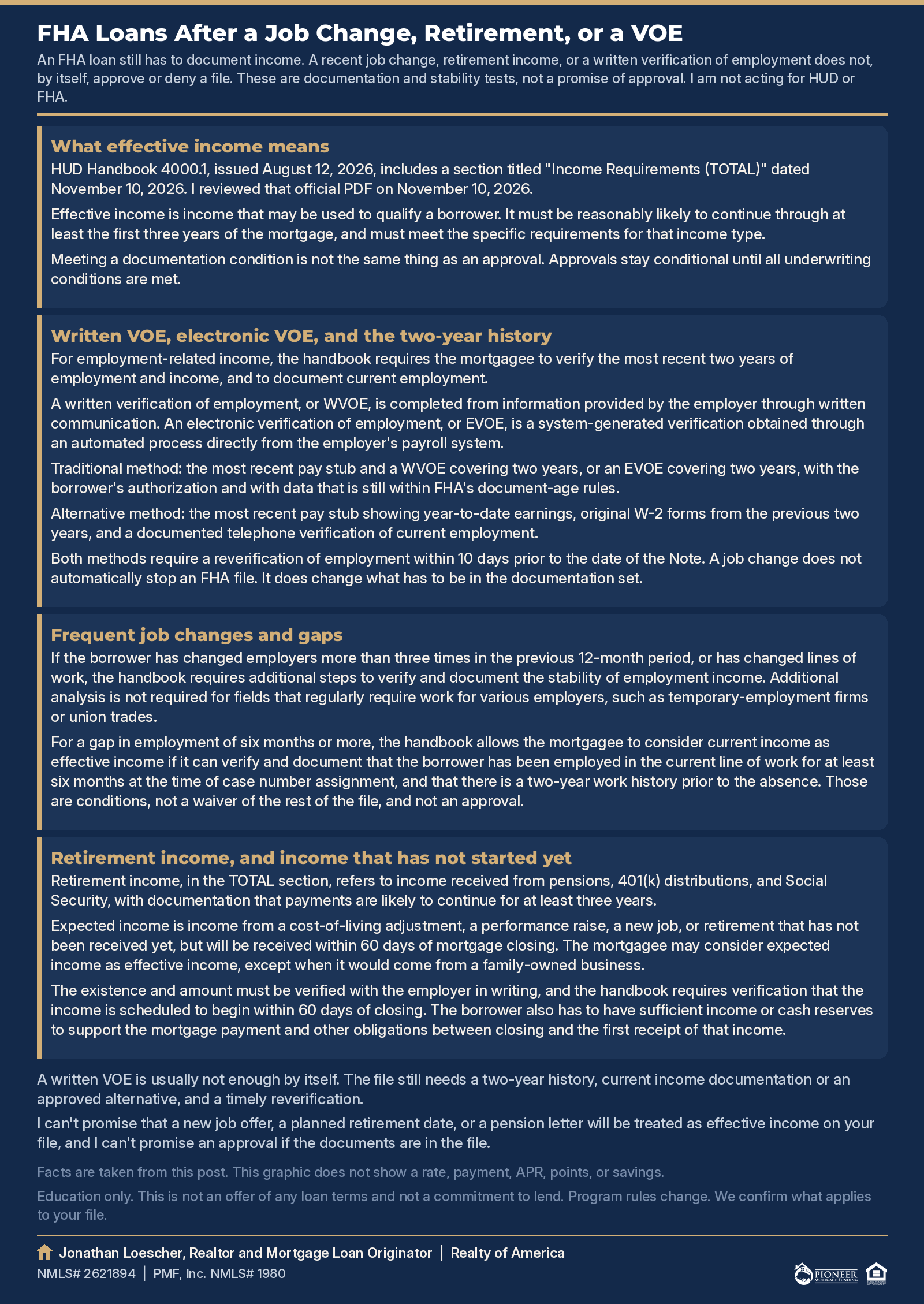
HUD Handbook 4000.1, issued August 12, 2026, includes a section titled "Income Requirements (TOTAL)" dated November 10, 2026. I reviewed that official PDF on November 10, 2026. Effective income is income that may be used to qualify a borrower. The handbook says effective income must be reasonably likely to continue through at least the first three years of the mortgage, and must meet the specific requirements for that income type.
The mortgagee has to document the borrower's income and employment history, verify the amounts being reported, and then decide whether that income can be considered effective income under those written rules. Meeting a documentation condition is not the same thing as an approval. Approvals stay conditional until all underwriting conditions are met.
Written VOE, electronic VOE, and the two-year history
For employment-related income, the handbook requires the mortgagee to verify the most recent two years of employment and income, and to document current employment. A written verification of employment, or WVOE, is a document-based employment verification completed from information provided by the employer through written communication. An electronic verification of employment, or EVOE, is a system-generated verification obtained through an automated process directly from the employer's payroll system.
Under the traditional method, the file needs either the most recent pay stub and a WVOE covering two years, or an EVOE covering two years, with the borrower's authorization and with data that is still within FHA's document-age rules. There is also an alternative method that uses the most recent pay stub showing year-to-date earnings, original W-2 forms from the previous two years, and a documented telephone verification of current employment. In both methods, the handbook requires a reverification of employment within 10 days prior to the date of the Note.
If you have not been with the same employer for the previous two years, or if the conditions for skipping past-employment verification are not met, the handbook requires one or a combination of W-2 forms, WVOE or EVOE records, and, where it applies, evidence of school or military enrollment during those two years. A job change does not automatically stop an FHA file. It does change what has to be in the documentation set.
Frequent job changes and gaps in employment
If the borrower has changed employers more than three times in the previous 12-month period, or has changed lines of work, the handbook requires additional steps to verify and document the stability of employment income. Additional analysis is not required for fields that regularly require work for various employers, such as temporary-employment firms or union trades. Where additional analysis is required, the mortgagee must obtain transcripts of training and education that demonstrate qualification for a new position, or employment documentation that shows continual increases in income, benefits, or both.
For a gap in employment of six months or more, the handbook allows the mortgagee to consider current income as effective income if it can verify and document that the borrower has been employed in the current line of work for at least six months at the time of case number assignment, and that there is a two-year work history prior to the absence. Those are conditions in the handbook. They are not a waiver of the rest of the file, and they are not an approval.
Retirement income, and income that has not started yet
Retirement income, in the TOTAL section, refers to income received from pensions, 401(k) distributions, and Social Security. For a pension, the mortgagee must verify and document periodic payments from the former employer and that the payments are likely to continue for at least three years, using tax returns, a recent bank statement showing receipt, or the pension or retirement letter. For IRA or 401(k) distribution income, the mortgagee must verify recurring distributions that are reasonably likely to continue for three years, using the most recent account statement plus tax returns or a bank statement showing receipt. Social Security income other than disability has its own documentation list, including a requirement that the income be likely to continue for at least a three-year period from the date of case number assignment.
The handbook also has a separate category called expected income. That is income from a cost-of-living adjustment, a performance raise, a new job, or retirement that has not been received yet, but will be received within 60 days of mortgage closing. The mortgagee may consider expected income as effective income, except when it would come from a family-owned business. The existence and amount must be verified with the employer in writing, and the handbook requires verification that the income will definitely begin within 60 days of closing, not just a planned start date. For expected retirement income, the amount and a definite start within 60 days of closing have to be verified. The borrower also has to have sufficient income or cash reserves to support the mortgage payment and other obligations between closing and the first receipt of that income.
I'm describing those handbook conditions only. I can't promise that a new job offer, a planned retirement date, or a pension letter will be treated as effective income on your file, and I can't promise an approval if the documents are in the file.
When an FHA path may not be the fit
If the income cannot be documented under FHA's written rules, another path may need to be reviewed, including a conventional file or, in some cases, a Non-QM path. See what a non-QM loan is. That is a file review, not a suggestion that Non-QM is a way to skip verification.
How I can help
I start with the income you actually receive, or will begin receiving, and with the documents the handbook asks for on that income type. Then I can tell you whether an FHA file looks documentable, or whether we should look at another path, without promising an approval.
As a Realtor with Realty of America, I can help you with the purchase. As a Mortgage Loan Originator with PMF, Inc., I can help with the loan. PMF, Inc. is a mortgage broker that works with many wholesale lenders, so I can compare options for your situation. Rates and terms vary by lender, program and borrower, and I can't promise any particular rate or approval. You can use one or both. You don't have to use both. I am not acting for HUD or FHA.
Apply for a mortgage or book a consultation. Any loan approval is conditional until all underwriting conditions are met.
Common questions
Does a job change in the last two years stop an FHA loan?
No, not automatically. The handbook still requires a two-year employment and income history, and a recent change can mean more documents, or additional stability analysis if you have changed employers more than three times in 12 months or changed lines of work. That is a documentation test, not an automatic denial or an automatic approval.
Can I use a job I have accepted but have not started?
Only if the file meets the handbook's expected-income conditions, including written verification that the income will definitely begin within 60 days of closing, and a plan for the payments due before that income starts. Expected income from a family-owned business is not eligible under that section. I can't promise the offer letter you have will meet those conditions.
Is a written VOE enough by itself?
Usually no. A written VOE is one way to document current or past employment. The file still needs a two-year history, current income documentation or an approved alternative, and a timely reverification. Other parts of the FHA file still have to fit.
This article is for education only. It is not an offer of any loan terms and not a commitment to lend. Program rules change. We confirm what applies to your file.
Jonathan Loescher, Realtor, Florida real estate license SL3546365, Realty of America. Jonathan Loescher, Mortgage Loan Originator, NMLS 2621894. Mortgage loans are originated through PMF, Inc., NMLS 1980, a Florida licensed Mortgage Broker. Real estate and mortgage services are provided by separate companies, and you don't have to use both. Verify licensing at www.nmlsconsumeraccess.org. Equal Housing Opportunity.
Education only. This is not a commitment to lend. All loans are subject to credit approval, underwriting, and property eligibility. Not all applicants will qualify. Any loan approval is conditional until all underwriting conditions are met. Programs, rates, terms and conditions may change without notice.
Common questions
- What is the average mortgage rate in Florida today?
- I don't post averages here. Rates move often, and your rate depends on your credit, loan program, down payment, property type, occupancy, and lock period. A published average can be far from what you'd get. Ask for a quote on your own scenario, dated, with the program and terms. Any loan approval is conditional until all underwriting conditions are met.
- How often do mortgage rates change?
- Often. Pricing can change daily, sometimes more than once, as bond markets move. Your quote also changes if your credit, down payment, program, or property changes. That's why quotes are dated. A rate lock holds pricing for a set period once you're under contract. Any loan approval is conditional until all underwriting conditions are met.
- What is a rate lock?
- A rate lock holds your rate and pricing for a set number of days while your loan closes. If the market rises, your lock holds. If closing slips past it, an extension may cost extra. Longer locks can cost more. Changes to your file, like the price or credit, can reprice it. Any loan approval is conditional until all underwriting conditions are met.
- What is the difference between pre-approval and pre-qualification?
- Pre-qualification is a conversation about income and credit. Pre-approval is a lender review of a file. Apply on this site for a second look even if you already have a letter from somewhere else.
- What Florida mortgage loan programs can a Mortgage Loan Originator offer?
- Common programs include conventional, FHA, VA, cash-out refinance, and non-QM loans like bank statement and DSCR. Some pair with down payment assistance. The right one depends on your file. You don't have to use both companies. Any loan approval is conditional until all underwriting conditions are met.
More Tampa Bay home and loan answers on Ask Jonathan.
Enjoying this? Make us a preferred source on Google.