
Buying
Pinellas Condos After SB 4-D: Vetting Reserves, SIRS and Assessments
Condos can be one of the more affordable ways to own in Pinellas. I wrote about that in why condos are the starter home buyers keep skipping. This post is the other half. Once you find a unit you like, how do you know the building is sound, and that you won't get hit with a surprise bill?
Since the Surfside collapse, Florida has rewritten its condo safety rules. SB 4-D in 2022 created the main framework, and HB 913 in 2025 adjusted it. Here's how I vet a building today.
The three reports that matter most
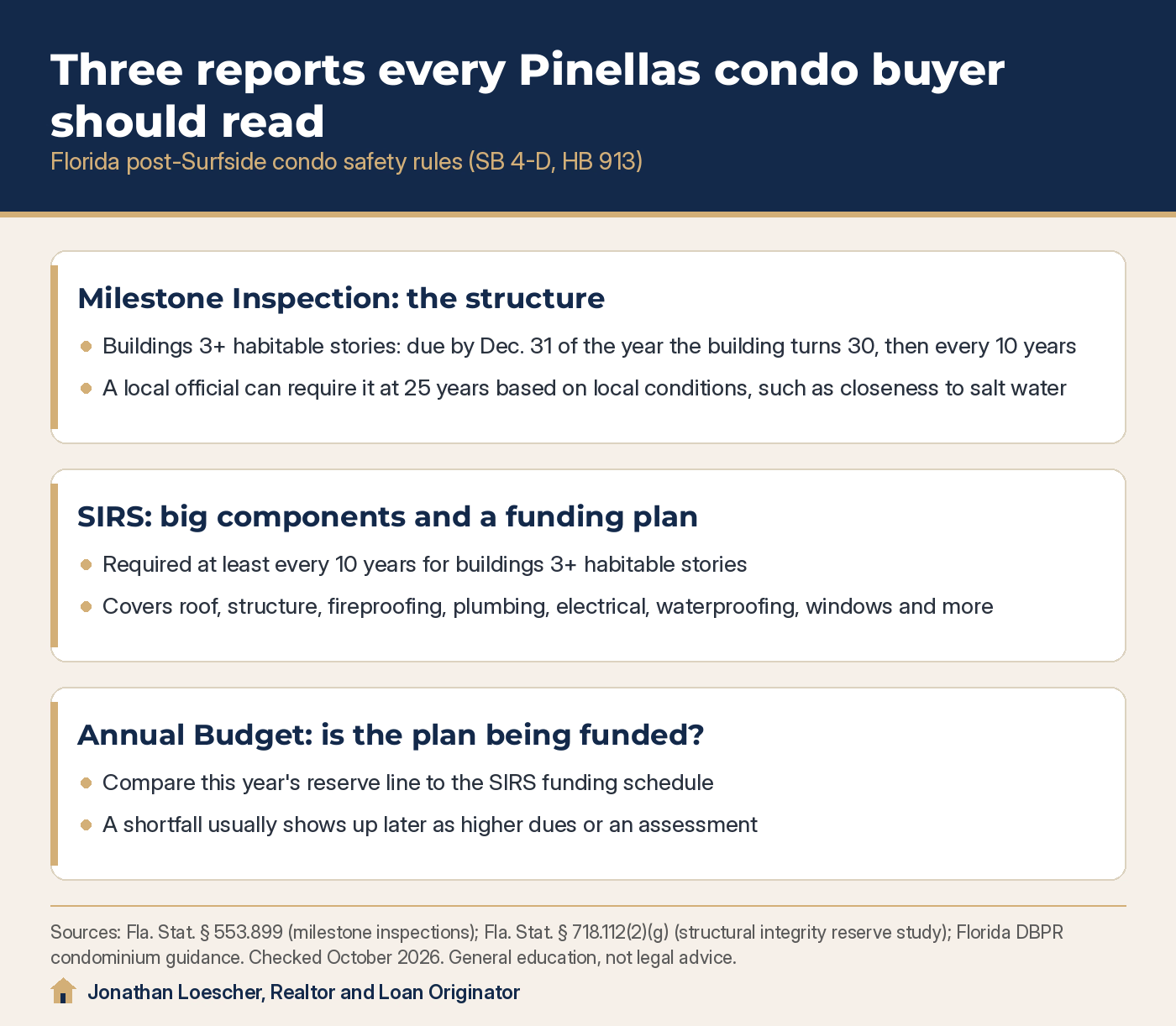
The milestone inspection. Under section 553.899, condo and co-op buildings three habitable stories or taller need a structural milestone inspection by December 31 of the year the building turns 30, then every 10 years. A local building official can require it at 25 years based on local conditions, including closeness to salt water. That matters for a lot of Pinellas buildings.
The structural integrity reserve study, or SIRS. Under section 718.112(2)(g), associations with buildings three habitable stories or taller need a SIRS at least every 10 years. It covers the roof, structure, fireproofing and fire protection, plumbing, electrical, waterproofing and exterior painting, windows and exterior doors, and other big items over $25,000 that affect those. DBPR says most qualifying associations had to have one done by December 31, 2025. If the milestone inspection is due by the end of 2026, the SIRS can be done alongside it, but no later than December 31, 2026.
The budget and reserve schedule. The SIRS sets a funding plan. The budget tells you whether the association is following it.
What you're entitled to see
Florida law gives resale buyers a right to these documents. Under section 718.503(2), a buyer under contract is entitled, at the seller's expense, to the declaration, articles, bylaws and rules, the annual budget and financial statement, the inspector's summary of the milestone inspection if one applies, the most recent SIRS or a statement that one hasn't been done, a turnover inspection report if applicable, and the condo FAQ sheet.
Under section 718.503, you also have 7 days, not counting weekends and legal holidays, to cancel after you receive the required documents. That right ends at closing. For contracts after December 31, 2024, the contract also has to say in plain type if the association was required to complete a milestone inspection or SIRS and hasn't.
Starting January 1, 2026, associations with 25 or more units also have to post many of these records on a website or app for owners.
My advice: ask for the documents before you write the offer, not after. I'd rather spend a day reading than have you pay for inspections and an appraisal on a building that won't work.
How I read a SIRS
- When was it done? An older study may not reflect current costs.
- Which items are near the end of their life? A roof or waterproofing project due in a few years is a likely assessment if the money isn't there.
- Does the budget match the plan? Compare the SIRS funding schedule to what's in this year's budget. If the budget is short, the gap usually shows up later as higher dues or an assessment.
- Is there a pause in place? HB 913 lets an association that recently finished a milestone inspection pause or reduce reserve contributions for up to two annual budgets, if a majority of all the association's voting interests approve (not just a majority of those who show up), to pay for repairs the inspection recommended. It doesn't apply to developer-controlled associations or ones that owners have controlled for less than a year. That can be reasonable. It also means a new SIRS is required before contributions restart.
One rule you should know: for budgets adopted on or after December 31, 2024, owners in an association that needs a SIRS can't vote to use those structural reserves for other purposes. Older buildings used to waive reserves. That door is mostly closed for the structural items now.
Assessments: how they show up
When reserves are short, an association has a few options. HB 913 lets a unit-owner-controlled association fund required reserves with a special assessment, a loan or a line of credit, with approval from a majority of the total voting interests. Each one costs you something. An assessment is a bill. A loan usually shows up as higher dues for years.
Ask the association, in writing, about any approved or proposed assessments, any loans, and any pending litigation. Read recent board minutes. Boards usually discuss big projects long before they vote.
Flood and the 49% rule for condo buildings
In unincorporated Pinellas and the towns where the county is the building official, including Indian Rocks Beach and Belleair Beach, the county treats a condo building as one structure under its substantial damage and improvement rule. If repair costs reach 49% of the building's value, the whole building must meet current flood standards. Many Pinellas cities run their own building departments, so check with the right one.
Also ask for the master insurance policy and any building flood policy. Make sure they're current, not last year's certificate.
Financing a condo
Some loan programs review the building itself, not just you. The association's budget, reserves, insurance, litigation and share of rentals can all affect whether a project qualifies. I like to check that early. If you're considering FHA, my FHA guide covers condo approval at a high level. Program rules change, so we confirm at consult.
For more background, see milestone inspections and assessments and my reserve study checklist.
Let's vet a building together
If you've found a unit, request a tour on that listing and send me the address. If you want to talk through a building first, book a consultation. When you're ready to finance, you can apply for a loan. I can help with the purchase, the loan, or both.
General education, not legal advice. Have a Florida real estate attorney review association documents when the stakes are high.
Jonathan Loescher, Tampa Bay Realtor and Loan Originator (SL3546365, NMLS 2621894).
Real estate services through Realty of America. Mortgage loans originated through PMF, Inc., NMLS 1980. You don't have to use both. Equal Housing Opportunity. All loan approvals are conditional.
Common questions
- Where is Bayou Club in Seminole, Florida?
- Bayou Club Estates is a gated golf community on the Seminole and Largo edge of Pinellas County. Most listings use a Seminole city and ZIP 33777. The gate is off Belcher Road. It is not in Seminole County. Open the Bayou Club homes for sale search for live listings.
- Where is Oakhurst Shores in Seminole, Florida?
- Oakhurst Shores is a west Seminole neighborhood in Pinellas County near Oakhurst Drive, Grove Street, and Boca Ciega Bay. Most sale files use ZIP 33772. It is not in Seminole County. Many homes may have water frontage, however being in this community does not guarantee water frontage. Search live files on the Oakhurst Shores homes for sale page.
- Where is Yacht Club Estates in Seminole, Florida?
- Yacht Club Estates is a Seminole neighborhood in Pinellas County. Listings cluster on streets such as Portside Drive and Commodore Drive in ZIP 33776. It is not Seminole County. The yacht-club name does not guarantee a slip or dock. Search live files on the Yacht Club Estates homes for sale page.
- What is the average mortgage rate in Florida today?
- Rates move. Your rate depends on the loan type, the property, and the file. Book a call and I will walk today's options against your situation. Apply at jonathanloescher.com/apply when you want a file review.
- How often do mortgage rates change?
- They can move on any business day as markets reprice. A rate you saw last week is not your rate. Apply for a loan at jonathanloescher.com/apply when you want a file review, not a headline number.
More Tampa Bay home and loan answers on Ask Jonathan.
Enjoying this? Make us a preferred source on Google.
Have a question about how this applies to your home or loan?
Book a Call