
Selling
Price Cut or Rate Buydown? A Guide for Tampa Bay Sellers
If your home is sitting, a price cut isn't your only move. You can also offer to pay for a rate buydown. That's money at closing that lowers the buyer's mortgage rate, either for a few years or for the whole loan. The same dollars can land very differently for a buyer. Here's how to compare them in Pinellas and Hillsborough.
Last updated November 9, 2026. Figures are from the sources linked below, as of their publication dates. Example rates and APRs are as of November 9, 2026.
Why are so many sellers cutting prices?
Buyers have choices right now. HousingWire Data reported (October 28, 2026) that 43.1% of active single-family listings had at least one price reduction in the week ending October 23. A year earlier it was 41.9%.
Redfin estimated (October 14, 2026) there were 62.6% more home sellers than buyers in the U.S. in September 2026. That was the biggest gap in its records back to 2013. In the Tampa metro, Redfin estimated 103.7% more sellers than buyers. That's roughly two sellers for every buyer.
When buyers have that much choice, they negotiate. Price is the first thing most of them push on.
What is a rate buydown?
A buydown is money paid at closing to lower the buyer's interest rate. When you pay it as the seller, you're prepaying some of the buyer's interest. The buyer gets a lower rate and a lower monthly payment, at least for a while.
There are two main kinds.
Temporary buydown
The rate is lower for the first year or few years, then goes to the full rate. In a 2-1 buydown, the rate is two percentage points lower in year one and one point lower in year two, according to FICO. From year three on, the buyer pays the full payment. FICO notes these generally cost about what the buyer saves in interest. This can fit a buyer who expects income to rise or plans to refinance. A refinance is never guaranteed.
Permanent buydown
The rate is lower for the life of the loan. It's paid with discount points. One point equals 1% of the loan amount. How much each point lowers the rate depends on the loan and the day's pricing, so I only quote it from a dated rate sheet. This can fit a buyer who plans to stay a long time.
How does the same money compare three ways?
Say you're willing to give $10,000 to get a deal done. You could cut the price. You could offer a seller credit toward points. Or you could pay for a 2-1 buydown. Each changes the buyer's payment differently.
Here's a comparison from pricing as of November 9, 2026. It's a conventional 30-year fixed loan on a $525,000 purchase. The loan amount is $420,000, or 80% of the price, with $105,000 down. Primary residence, single-family home, a typical purchase in Pinellas or Hillsborough, a representative credit score of 740, and a 30-day lock. I used the closest figures I could get that day. This is not a quote for a specific house or a specific buyer.
The base rate, with no extra points
The rate is 7.490% (7.650% APR). Points were -0.058%, or a $244 credit. Principal and interest is $2,934 a month. In this example, the payment with taxes and insurance is $3,634.
A $10,000 price cut
You sell for $515,000. At 80% loan-to-value, the buyer's loan is $412,000, with $103,000 down. The rate is 7.490% (7.654% APR). Points were -0.058%, or a $239 credit. Principal and interest is $2,878 a month. That's $56 less than the base payment of $2,934. In this example, the payment with taxes and insurance is $3,585.
Permanent points, closest available to $10,000
The rate is 6.740% (7.145% APR). That took 2.465 points, or $10,353. Those were the closest available figures, not an exact $10,000. The 7.145% APR includes those points as a finance charge. In this example, the seller would credit $10,353 toward them, which lowers the buyer's cash to close. Principal and interest is $2,721 a month, $213 less than the base payment. In this example, the payment with taxes and insurance is $3,421.
A seller-paid 2-1 buydown
The note rate came in at 7.500% (7.670% APR), 0.01% above the 7.490% base. I'm keeping both as they were priced. In year one, the rate is 5.500% and principal and interest is $2,384.71. In year two, it's 6.500% and $2,654.69. From year three through year 30, the payment is $2,936.70 at the note rate, $2.70 more than the base payment because of that 0.01% difference. The total buydown cost was $10,008.
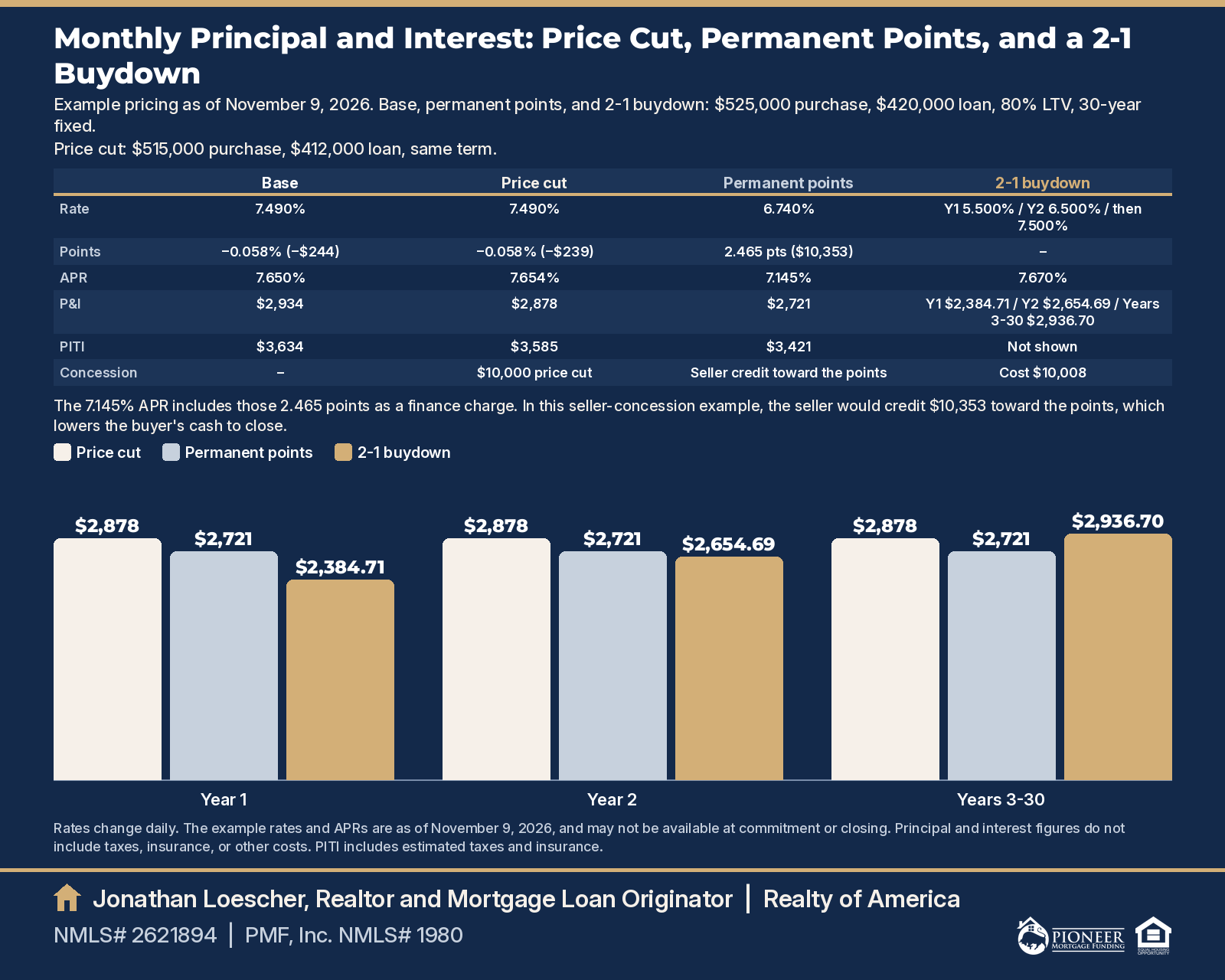
Example rates and annual percentage rate (APR) figures are as of November 9, 2026, and assume a conventional 30-year fixed purchase, a representative credit score of 740, a single-family primary residence, a typical Pinellas or Hillsborough County purchase, and a 30-day lock. The base quote is a $525,000 purchase price and a $420,000 loan amount (80% loan-to-value, $105,000 down payment). The base rate of 7.490% (7.650% APR) includes -0.058% points (a $244 credit). The price-cut example is a $515,000 purchase price and a $412,000 loan amount (80% loan-to-value, $103,000 down payment), at 7.490% (7.654% APR), with -0.058% points (a $239 credit). Principal and interest on that loan is $2,878 a month. The permanent-points rate of 6.740% (7.145% APR) includes 2.465 points ($10,353), which were the closest available figures, not an exact $10,000. The 7.145% APR includes those 2.465 points as a finance charge. In this seller-concession example, the seller would credit $10,353 toward them, which lowers the buyer's cash to close. The 2-1 buydown note rate of 7.500% (7.670% APR) had a total buydown cost of $10,008. Rates change daily. These rates and APRs may not be available at commitment or closing. Taxes and insurance figures in this example are estimates and vary by property. Your payment will be higher if taxes, insurance, and any mortgage insurance are included.
Most buyers shop by monthly payment. In this example, the price cut lowered principal and interest by $56 a month for the life of the loan. The permanent points lowered it by $213 a month for the life of the loan, with a $10,353 seller credit toward the points. The 2-1 buydown dropped the first-year payment the most, then stepped up, and the payment from year three through year 30 was slightly higher than the base quote. Which one fits depends on the buyer.
What should sellers know before offering a buydown?
- Loan programs cap seller help. How much you can pay toward a buyer's costs depends on the loan type and the down payment, as FICO notes. Check the limit before you promise a number.
- A buydown doesn't end negotiation. Buyers can still ask for repairs or other credits after inspection.
- Put it in the listing. If buyers and their agents know it's on the table, it can help your home stand out.
- Run the numbers before an offer comes in. Then you'll know your floor and can answer fast.
- The buyer's lender has to offer it. Not every loan or lender handles every buydown the same way.
Is a price cut ever the better choice?
Yes. If your price is above what similar homes have sold for, a buydown won't fix that. The appraisal still has to support the price. And some buyers care more about cash at closing or the price itself than the payment.
NAR Chief Economist Lawrence Yun said it well in NAR's October 13, 2026 existing-home sales release: "Home sellers need to be realistic about local market conditions, which could require price discounts and other incentives to attract buyers."
Local is the key word. A condo on the beach and a three-bedroom house in Riverview are different markets.
How I can help on both sides
I'm a Realtor, and I'm also a Mortgage Loan Originator. As a Realtor, I can show you what similar homes near you sold for and where your price sits. As a Mortgage Loan Originator, I can run buydown scenarios on a dated rate so you see real payments, not guesses. They are separate companies, and you don't have to use both.
If you want to compare a price cut and a buydown on your home, book a consultation. You can also check your home's value first.
Common questions
What is a 2-1 buydown?
It's a temporary buydown. The buyer's rate is two percentage points lower in year one and one point lower in year two. From year three on, the buyer pays the full rate.
Is a rate buydown better than a price cut?
It depends on the buyer and the home. A buydown usually lowers the monthly payment more in the early years. A price cut lowers the loan amount for good. Your price still has to match the market.
How much can a seller pay toward a buyer's buydown?
Loan programs set limits on seller contributions. The limit depends on the loan type and the down payment. We confirm it for the buyer's specific loan before you commit.
This article is for education only. It is not a prediction of any home's value and not an offer of any rate or loan terms. Rates change daily. Any example rate and APR are as of the date stated and may not be available at commitment or closing.
Jonathan Loescher, Tampa Bay Realtor and Mortgage Loan Originator (SL3546365, NMLS 2621894). Verify licensing at www.nmlsconsumeraccess.org.
Real estate services are offered through Realty of America. Mortgage loans are offered through PMF, Inc., NMLS 1980. They are separate companies, and you don't have to use both. Equal Housing Opportunity. This is not a commitment to lend. All loans are subject to credit approval, underwriting, and property eligibility. Not all applicants will qualify. Any loan approval is conditional until all underwriting conditions are met.
Common questions
- What does it cost to sell a home in Tampa Bay?
- Typical costs include payoff of the mortgage, negotiated brokerage compensation, title, prorated taxes, HOA or CDD transfer items, and any credits. Ask for a net sheet. Online estimates are not appraisals.
- What are seller closing costs in Florida?
- Sellers usually pay deed doc stamps, agreed brokerage fees, their loan payoff, prorated taxes, and often the owner's title policy in Pinellas and Hillsborough. HOA estoppel and any repairs or credits can add to it. The contract decides who pays what. Ask the title company for a seller net sheet before you list.
- Should I sell before I buy in Tampa Bay?
- Sell-first is the simpler calendar. If you must close the next Pinellas home before the current one funds, ask about a third-party buy-before-you-sell program. Any fee is set by that program, not a brokerage commission. I can model both as Realtor and as Mortgage Loan Originator. We confirm the file at consult.
- How long does it take to sell a house in Pinellas County?
- It depends on price, condition, and your part of the market. Plan for three stages: prep, time on market, and contract to closing. The closing stretch depends on the buyer's loan, inspections, insurance, and any condo approval. Cash closes faster. I'll pull recent solds for your street rather than quote an average.
More Tampa Bay home and loan answers on Ask Jonathan.
Enjoying this? Make us a preferred source on Google.