
Selling
The Silver Tsunami and Selling Your Tampa Bay Home
The "silver tsunami" is the idea that homes owned by older Americans will come back to the market as owners age. Realtor.com projects about 13.9 million of those homes will change hands between 2026 and 2036. That's roughly 1.3 to 1.5 million a year. It's a slow shift, not a flood. If you're selling in Pinellas or Hillsborough, your local market matters far more.
Last updated November 9, 2026. Figures are from the sources linked below, as of their publication dates.
What is the silver tsunami?
It's a nickname for a real trend. Baby Boomers and the Silent Generation own a lot of homes. As they reach their late 70s and 80s, many will move, downsize, move in with family, or pass their homes on.
The word "tsunami" makes it sound sudden. It's easy to picture a wave of listings sinking prices overnight. So I looked at what the research actually says.
How many homes are expected to change hands, and how fast?
In its 2026 Generational Housing Succession report (October 5, 2026), Realtor.com estimates that Boomers and the Silent Generation own and live in about 36.7 million homes in 2026. By 2036, it projects that number falls to about 22.8 million.
That gap is about 13.9 million homes over ten years. Realtor.com projects about 1.27 million in 2027, rising to about 1.52 million in 2036. The average is about 1.39 million a year.
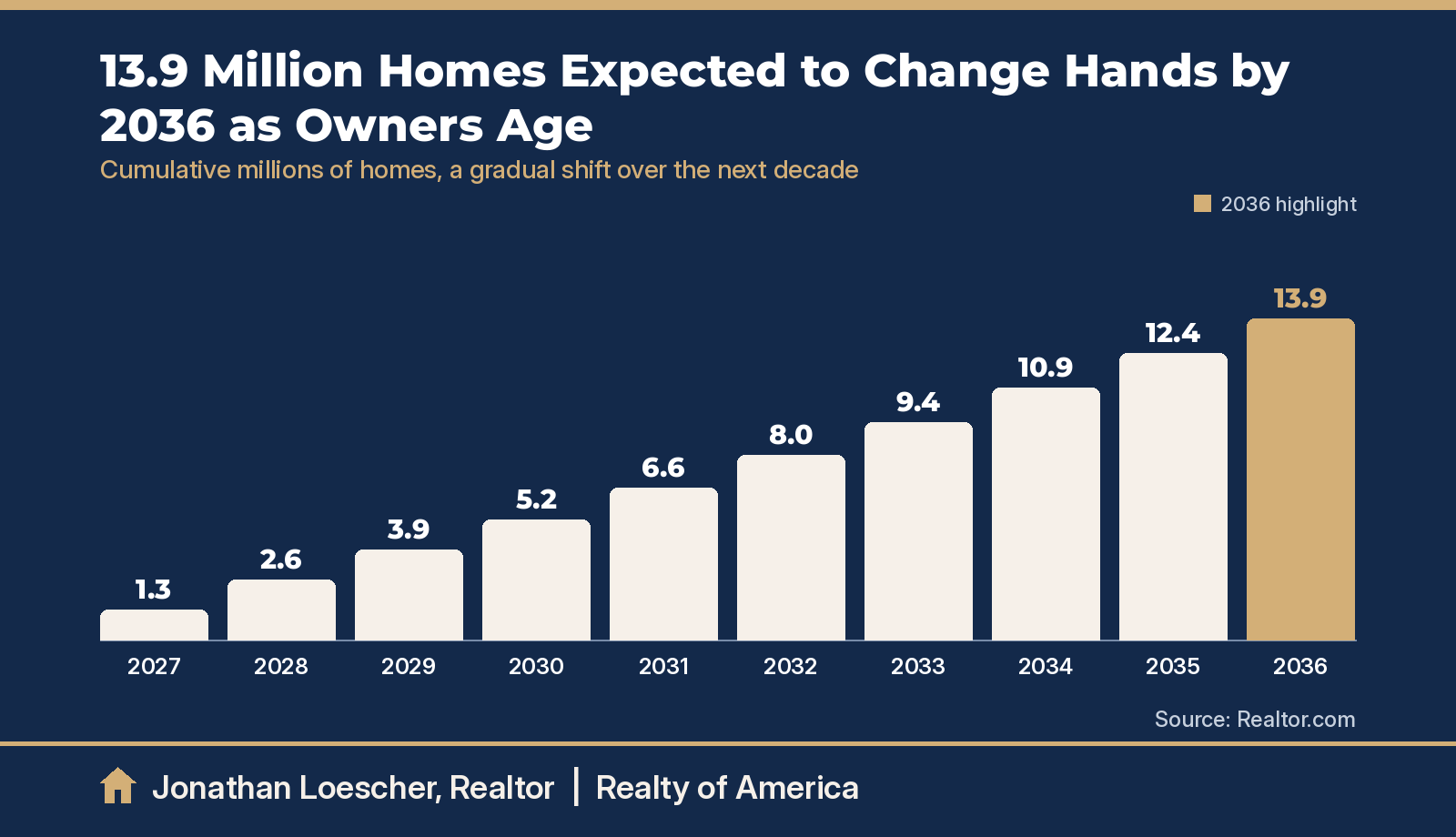
Two details matter here. First, the number builds year by year. Second, "change hands" doesn't mean "listed for sale." Realtor.com counts homes that owners leave for any reason. Some will be inherited, kept in the family, or rented out. Not all of them will show up on the market.
Is there room in the market for these homes?
Yes. The country has been short on homes for years.
The White House Council of Economic Advisers put it plainly in the April 2026 Economic Report of the President (chapter 6, page 139): "If homebuilding and the growth of the single-family housing stock had continued at their historical pace instead of falling dramatically after 2008, there would be 10 million or more additional single-family homes today."
Realtor.com makes a similar point. It says this handoff alone isn't big enough to solve the national shortage, but it will help.
New households will need homes too. In a January 6, 2025 projection, Harvard's Joint Center for Housing Studies estimates the number of U.S. households will increase by 8.6 million, or about 860,000 a year, from 2025 to 2035. To be fair, that's slower growth than in past decades. So more supply can mean a more balanced market over time, not a crash.
Which homes will this affect most?
Not every home type gets the same wave. Realtor.com projects:
- Starter homes (0 to 2 bedrooms): about 0.38 million released over the decade. That's a small effect.
- Family homes (3 to 4 bedrooms): about 9.9 million. That's most of the total.
- Large homes (5 or more bedrooms): about 3.6 million. That's the biggest effect relative to how many are listed today.
Realtor.com also expects the effect to be uneven by region. It says any softening would likely be gradual and concentrated in certain home types and slower-growing metros, not one drop everywhere at once.
If you own a three- or four-bedroom home in Pinellas or Hillsborough, that's useful long-term context. It isn't a reason to rush or to wait.
What matters more when you sell in Tampa Bay?
What's happening on your street right now. A ten-year national projection can't price your home.
Here's a local number. Redfin reported (October 14, 2026) that the Tampa metro had an estimated 103.7% more sellers than buyers in September 2026. Nationally, it was about 63%. That's a buyer's market by Redfin's definition. And that's as of September 2026, not 2036.
When we look at your sale together, whether you're in St. Pete, Clearwater, Brandon or South Tampa, we start with three things:
- How many similar homes are for sale nearby. That tells you how much choice your buyer has.
- What similar homes actually sold for. We use closed sales, not list prices.
- What buyers want right now. Here that often includes condition, roof age, flood history and insurance costs.
Those answers change by zip code and by month. A beach condo and a three-bedroom house in Riverview sell in different markets.
Should I wait to sell because of the silver tsunami?
I wouldn't plan a move around it. The research points to a slow shift over ten years. Your timing should come from your life and your local numbers.
If you want a starting point, check your home's value. If you'd rather talk about your street, book a consultation and I'll walk you through what's selling near you.
Common questions
Will the silver tsunami make Tampa Bay home prices drop?
No one can promise that either way. Realtor.com expects any national softening to be gradual and uneven by region and home type. What drives your price is local supply and demand right now.
How many homes will older Americans release by 2036?
Realtor.com projects about 13.9 million homes owned by Baby Boomers and the Silent Generation will change hands from 2026 to 2036. That's about 1.27 million in 2027, rising to about 1.52 million in 2036.
Will all of those homes be listed for sale?
No. Realtor.com counts homes that owner-occupants leave for any reason. Some will be inherited, kept, or rented out.
This article is for education only. It is not a prediction of any home's value. Projections are from the sources named and can change.
Jonathan Loescher, Tampa Bay Realtor and Mortgage Loan Originator (SL3546365, NMLS 2621894). Verify licensing at www.nmlsconsumeraccess.org.
Real estate services are offered through Realty of America. Mortgage loans are offered through PMF, Inc., NMLS 1980. They are separate companies, and you don't have to use both. Equal Housing Opportunity. This is not a commitment to lend. Any loan approval is conditional until all underwriting conditions are met.
Common questions
- How do I start buying a home in Tampa Bay?
- Start with a consult and a pre-approval. Pick two or three areas, sign a buyer agreement, and tour. Get insurance quotes early. I'm a Realtor and, separately, a licensed Mortgage Loan Originator with PMF, Inc. Those are two separate companies, and you don't have to use both. Any loan approval is conditional until all underwriting conditions are met.
- What are the first-time home buyer steps in Tampa Bay?
- Check your budget and credit. Get pre-approved and ask about down payment assistance. Sign a buyer agreement, tour homes, and make an offer. Inspect and get insurance quotes. Clear your loan conditions and close. File homestead after you move in. Any loan approval is conditional until all underwriting conditions are met.
- How much are closing costs in Florida for a buyer?
- It depends on your price, loan, and contract. Buyers usually pay loan fees, appraisal, the lender's title policy, settlement and recording fees, and Florida's doc stamp and intangible taxes on the new mortgage. Prepaids add homeowners insurance, escrow for taxes, and interest. Your Loan Estimate shows them. Cash buyers skip the mortgage taxes and loan fees.
- What is earnest money in Florida?
- Earnest money is your good faith deposit after an accepted offer. It's held in escrow and credited at closing. The contract sets when it's due and when you can cancel and get it back, such as during the inspection period or under a financing contingency. Miss a deadline, and it can be at risk. Confirm wiring instructions by phone.
- How does the Florida buyer-broker agreement work after NAR?
- Compensation is negotiated in writing. It is not automatic that the seller pays. I will walk the buyer-broker agreement with you before you tour. Do not assume buyers pay nothing.
More Tampa Bay home and loan answers on Ask Jonathan.
Enjoying this? Make us a preferred source on Google.
Clearwater market snapshot
Live MLS figures for Clearwater.
- Homes for sale
- 1,418
- Median list price
- $325,500
- Median days on market
- 75
Listings courtesy of Beaches MLS and Stellar MLS
See homes in Clearwater