
Mortgage Guide
Asset Depletion Loans in Florida: Qualifying on Savings

An asset depletion or asset utilization loan is a way some mortgage programs turn documented savings or investment balances into a qualifying income figure, instead of relying only on a paystub. The method is written in the loan program, not in a nickname. It is not a path for every file.
This guide stays on that documentation question for Florida buyers and homeowners. It is not a general overview of loans without tax returns. For that wider Non-QM context, start with what a non-QM loan is. Some larger files also belong on flexible-income jumbo programs or the short FAQ on getting a mortgage without tax returns.
What do asset depletion and asset utilization mean?
People use both phrases for the same basic idea: verified assets, not a current paycheck, are used to support repayment. Those nicknames are not standardized official product names.
Fannie Mae's Selling Guide calls its agency version "Employment Related Assets as Qualifying Income." Freddie Mac's Guide has a written method for using assets as a basis for repayment of obligations. Some Non-QM programs use "asset depletion" or "asset utilization" for their own written methods. The file is underwritten to the program in front of you, not to the nickname on a blog post.
I won't paste a formula here. Official guides and program descriptions change, and a sample math example can read like a promised payment. If this path is in play, we use the current written method for that program and the verified statements in your file.
Is this only a Non-QM loan?
No. There is an agency path and there are Non-QM paths.
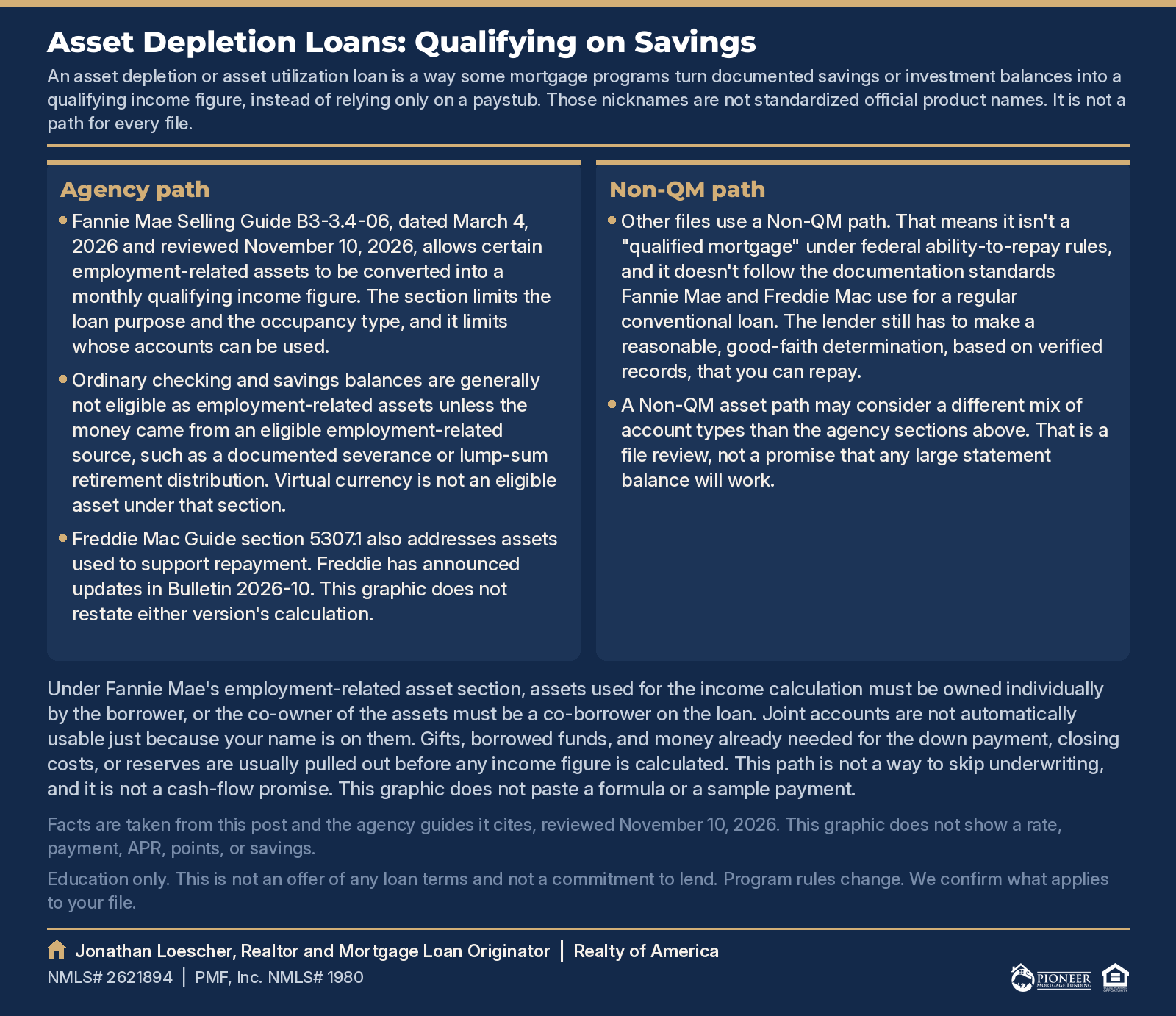
On the agency side, Fannie Mae Selling Guide B3-3.4-06, dated March 4, 2026 and reviewed for this article on November 10, 2026, allows certain employment-related assets to be converted into a monthly qualifying income figure. The section limits the loan purpose and the occupancy type, and it limits whose accounts can be used. Ordinary checking and savings balances are generally not eligible as employment-related assets unless the money came from an eligible employment-related source, such as a documented severance or lump-sum retirement distribution. Virtual currency is not an eligible asset under that section. If the file does not meet those parameters, other standard income rules may still apply, such as interest and dividend income or retirement distributions already being received.
Freddie Mac Guide section 5307.1 also addresses assets used to support repayment. Freddie has announced updates to that section in Bulletin 2026-10. The later version has a mandatory date in 2027, and sellers may implement the update earlier. I'm pointing you to the official Guide rather than restating either version's calculation here, because the current rule and the announced update are not identical.
Other files use a Non-QM path, usually through a Non-QM mortgage. That means it isn't a "qualified mortgage" under federal ability-to-repay rules, and it doesn't follow the documentation standards Fannie Mae and Freddie Mac use for a regular conventional loan. The lender still has to make a reasonable, good-faith determination, based on verified records, that you can repay. A Non-QM asset path may consider a different mix of account types than the agency sections above. That is a file review, not a promise that any large statement balance will work.
Whose assets can count?
Under Fannie Mae's employment-related asset section, assets used for the income calculation must be owned individually by the borrower, or the co-owner of the assets must be a co-borrower on the loan. Joint accounts are not automatically usable just because your name is on them.
Other programs have their own ownership, access, and seasoning rules. Retirement accounts often have extra questions about whether you can actually request a distribution, and whether a penalty would apply. Those details belong in the statements and the program rules, not in a shortcut I make up here.
Gifts, borrowed funds, and money already needed for the down payment, closing costs, or reserves are usually pulled out before any income figure is calculated. That is one reason a large headline balance can shrink once the file is underwritten.
What this path is not
It is not a way to skip underwriting. Assets still have to be sourced and documented. Credit, the property, and the rest of the application still matter. Approvals stay conditional until all underwriting conditions are met.
It is also not a guaranteed cash-flow story. Using assets to qualify does not mean those assets will last as long as the loan, and it does not replace a conversation about how you plan to make the payment.
If you are trying to compare loan types rather than this documentation question, which loan path fits is the broader menu.
Common questions
Is asset depletion the same thing as asset utilization?
Not officially. Lenders and articles use both phrases for asset-based qualifying. Fannie Mae and Freddie Mac use their own section titles. Ask which written method applies to the file, rather than relying on the nickname.
Can I use a regular savings account?
Sometimes, depending on the program and on where the money came from. Under Fannie Mae's employment-related asset section, ordinary checking and savings are generally not eligible unless the balance came from an eligible employment-related source. Other programs may treat depository accounts differently. The statements and the program rules decide it.
Do I still need tax returns?
Maybe. An agency asset path can reduce the need to use wage income, but other parts of the file can still involve tax documents. A Non-QM asset path has its own checklist. This is not a no-document loan.
If you want to see whether an asset path may fit your file, you can start a loan application. If you want to talk through the documents first, book a consultation.
This article is for education only. It is not an offer of any loan terms and not a commitment to lend. Program rules change. We confirm what applies to your file.
Jonathan Loescher, Realtor, Florida real estate license SL3546365, Realty of America. Jonathan Loescher, Mortgage Loan Originator, NMLS 2621894. Mortgage loans are originated through PMF, Inc., NMLS 1980, a Florida licensed Mortgage Broker. Real estate and mortgage services are provided by separate companies, and you don't have to use both. Verify licensing at www.nmlsconsumeraccess.org. Equal Housing Opportunity.
Education only. This is not a commitment to lend. All loans are subject to credit approval, underwriting, and property eligibility. Not all applicants will qualify. Any loan approval is conditional until all underwriting conditions are met. Programs, rates, terms and conditions may change without notice.
Common questions
- What is the average mortgage rate in Florida today?
- I don't post averages here. Rates move often, and your rate depends on your credit, loan program, down payment, property type, occupancy, and lock period. A published average can be far from what you'd get. Ask for a quote on your own scenario, dated, with the program and terms. Any loan approval is conditional until all underwriting conditions are met.
- How often do mortgage rates change?
- Often. Pricing can change daily, sometimes more than once, as bond markets move. Your quote also changes if your credit, down payment, program, or property changes. That's why quotes are dated. A rate lock holds pricing for a set period once you're under contract. Any loan approval is conditional until all underwriting conditions are met.
- What is a rate lock?
- A rate lock holds your rate and pricing for a set number of days while your loan closes. If the market rises, your lock holds. If closing slips past it, an extension may cost extra. Longer locks can cost more. Changes to your file, like the price or credit, can reprice it. Any loan approval is conditional until all underwriting conditions are met.
- What is the difference between pre-approval and pre-qualification?
- Pre-qualification is a conversation about income and credit. Pre-approval is a lender review of a file. Apply on this site for a second look even if you already have a letter from somewhere else.
- What Florida mortgage loan programs can a Mortgage Loan Originator offer?
- Common programs include conventional, FHA, VA, cash-out refinance, and non-QM loans like bank statement and DSCR. Some pair with down payment assistance. The right one depends on your file. You don't have to use both companies. Any loan approval is conditional until all underwriting conditions are met.
More Tampa Bay home and loan answers on Ask Jonathan.
Enjoying this? Make us a preferred source on Google.