
Mortgage Guide
ITIN and Foreign National Loans for Florida Home Buyers
Some Florida owner-occupied mortgage files use an Individual Taxpayer Identification Number, and some use a foreign national documentation path. Those are documentation and program questions, not a statement about national origin. Credit is considered under fair housing and equal credit opportunity rules, not based on where you or your family come from. There may be a path, but not for every file.
This article is limited to an owner-occupied home. If the occupancy question is second home versus investment property, use the separate FAQ on a second home vs investment property loan. I don't give immigration or tax advice. An ITIN is not an immigration status.
What is an ITIN, and what is it not?
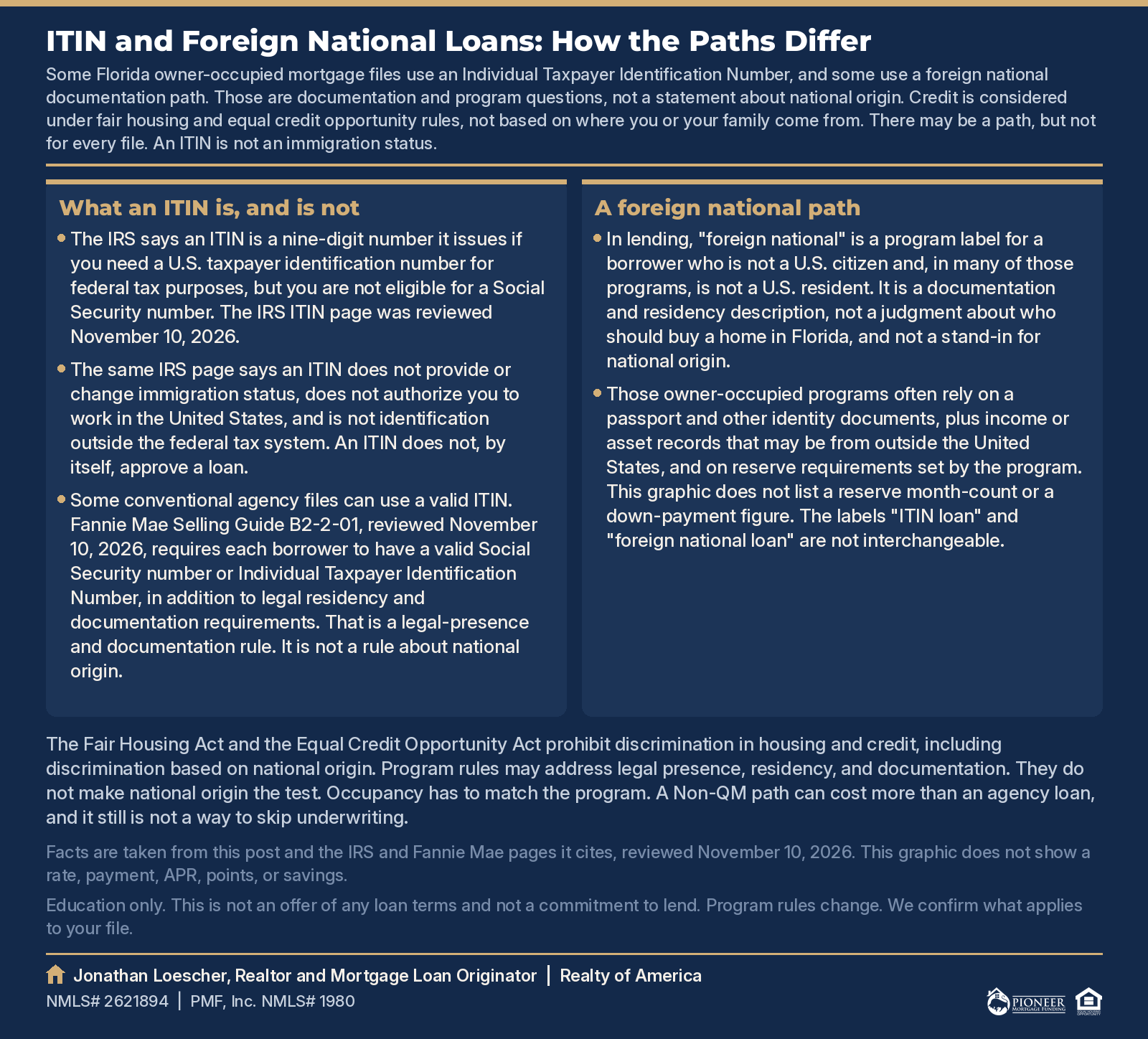
The IRS says an ITIN is a nine-digit number it issues if you need a U.S. taxpayer identification number for federal tax purposes, but you are not eligible for a Social Security number. I reviewed the IRS ITIN page on November 10, 2026.
The same IRS page says an ITIN does not provide or change immigration status, does not authorize you to work in the United States, and is not identification outside the federal tax system. If you need tax-filing help, that belongs with a tax professional, not with this mortgage article.
How can an ITIN show up on an owner-occupied loan?
Some conventional agency files can use a valid ITIN. Fannie Mae Selling Guide B2-2-01, dated September 3, 2025 and reviewed on November 10, 2026, requires each borrower to have a valid Social Security number or Individual Taxpayer Identification Number, in addition to legal residency and documentation requirements. Fannie Mae Selling Guide B2-2-02 says Fannie Mae purchases mortgages made to non-U.S. citizens who are lawful permanent or non-permanent residents of the United States under the same terms available to U.S. citizens, and that the lender has to determine legal presence based on the file. That is a legal-presence and documentation rule. It is not a rule about national origin.
Other owner-occupied files use a Non-QM path, usually through a Non-QM mortgage. That means it isn't a "qualified mortgage" under federal ability-to-repay rules, and it doesn't follow the documentation standards Fannie Mae and Freddie Mac use for a regular conventional loan. The lender still has to make a reasonable, good-faith determination, based on verified records, that you can repay.
I won't tell a story about "other programs turning you away." The right question is whether the file meets the written rules of a specific program, including identity, occupancy, income or asset documentation, credit, and reserves.
What does a foreign national documentation path usually mean?
In lending, "foreign national" is a program label for a borrower who is not a U.S. citizen and, in many of those programs, is not a U.S. resident. It is a documentation and residency description, not a judgment about who should buy a home in Florida, and not a stand-in for national origin.
Those owner-occupied programs often rely on a passport and other identity documents, plus income or asset records that may be from outside the United States, and on reserve requirements set by the program. I'm not listing a reserve month-count or a down-payment figure here. Some of those files also connect to flexible-income jumbo programs when the loan amount calls for it. Many of these loans, when they are available, are Non-QM loans with the same repayment review described above.
Federal agency programs can have their own citizenship or eligible non-citizen rules. Those rules belong on the official program pages. They are not a reason to assume a person is, or is not, a fit because of national origin.
What still has to be true on the file
Occupancy has to match the program. This article is about using the home as a primary residence. Reserves, down payment, and income or asset documentation still have to be verified. Credit still has to be reviewed, whether that is a U.S. credit report, an alternative credit history allowed by the program, or foreign credit documentation the program accepts.
A Non-QM path can cost more than an agency loan, and it still is not a way to skip underwriting. Approvals stay conditional until all underwriting conditions are met. If you want the broader menu of loan types, see which loan path fits and what a non-QM loan is.
Fair housing and neutrality
The Fair Housing Act and the Equal Credit Opportunity Act prohibit discrimination in housing and credit, including discrimination based on national origin. This page explains documentation paths. It does not target any country, language group, or immigration story, and it does not say who should apply. I will review a file against the program's written rules and against those fair housing and equal credit standards.
Common questions
Does having an ITIN automatically qualify me for a mortgage?
No. An ITIN is a tax-identification number. It does not, by itself, approve a loan, change immigration status, or replace the rest of the underwriting file.
Is a foreign national loan the same thing as an ITIN loan?
No. An ITIN file may involve a person who has a U.S. tax-identification number and, on some programs, U.S. residency and legal-presence questions. A foreign national program is often built for a non-resident buyer and a different documentation set. The labels are not interchangeable.
Does national origin decide which loan I can use?
No. National origin is a protected class. Program rules may address legal presence, residency, and documentation. They do not make national origin the test.
Not every lender offers an ITIN or foreign national path, and the ones that do set their own rules. I can originate ITIN and owner-occupied foreign national loans through PMF, Inc. Availability and terms vary by lender and property, approval is not guaranteed, and I'll tell you early whether any path is available for your file. Any loan approval is conditional until all underwriting conditions are met. If you want to see whether one may fit your documents, you can start a loan application, or book a consultation to talk it through first.
This article is for education only. It is not an offer of any loan terms and not a commitment to lend. Program rules change. We confirm what applies to your file.
Jonathan Loescher, Realtor, Florida real estate license SL3546365, Realty of America. Jonathan Loescher, Mortgage Loan Originator, NMLS 2621894. Mortgage loans are originated through PMF, Inc., NMLS 1980, a Florida licensed Mortgage Broker. Real estate and mortgage services are provided by separate companies, and you don't have to use both. Verify licensing at www.nmlsconsumeraccess.org. Equal Housing Opportunity.
Education only. This is not a commitment to lend. All loans are subject to credit approval, underwriting, and property eligibility. Not all applicants will qualify. Any loan approval is conditional until all underwriting conditions are met. Programs, rates, terms and conditions may change without notice.
Common questions
- What is the average mortgage rate in Florida today?
- I don't post averages here. Rates move often, and your rate depends on your credit, loan program, down payment, property type, occupancy, and lock period. A published average can be far from what you'd get. Ask for a quote on your own scenario, dated, with the program and terms. Any loan approval is conditional until all underwriting conditions are met.
- How often do mortgage rates change?
- Often. Pricing can change daily, sometimes more than once, as bond markets move. Your quote also changes if your credit, down payment, program, or property changes. That's why quotes are dated. A rate lock holds pricing for a set period once you're under contract. Any loan approval is conditional until all underwriting conditions are met.
- What is a rate lock?
- A rate lock holds your rate and pricing for a set number of days while your loan closes. If the market rises, your lock holds. If closing slips past it, an extension may cost extra. Longer locks can cost more. Changes to your file, like the price or credit, can reprice it. Any loan approval is conditional until all underwriting conditions are met.
- What is the difference between pre-approval and pre-qualification?
- Pre-qualification is a conversation about income and credit. Pre-approval is a lender review of a file. Apply on this site for a second look even if you already have a letter from somewhere else.
- What Florida mortgage loan programs can a Mortgage Loan Originator offer?
- Common programs include conventional, FHA, VA, cash-out refinance, and non-QM loans like bank statement and DSCR. Some pair with down payment assistance. The right one depends on your file. You don't have to use both companies. Any loan approval is conditional until all underwriting conditions are met.
More Tampa Bay home and loan answers on Ask Jonathan.
Enjoying this? Make us a preferred source on Google.