
Mortgage Guide
Assumable Mortgages in Florida
An assumable mortgage is a loan a buyer may take over, if the loan documents, the agency rules, and the servicer or agency allow it. Assumption is not automatic, and I can't promise that a specific loan can be assumed.
This is a process article. It does not replace the agency purchase guides. For program background, see FHA loan requirements in Florida, FHA loan programs, VA loan programs, and USDA loans near Tampa Bay.
What has to happen before a loan can be assumed?
The buyer usually starts with the current servicer, not with a new rate quote from a random lender. The servicer has an assumption package and a written process. The existing loan has to allow an assumption, the buyer has to qualify under the applicable rules, and the agency or servicer has to approve it. Until that written approval exists, you should not treat the loan as assumable just because a listing says it is.
Approval of the assumption and a release of the seller's personal liability are not always the same thing. Ask the servicer, in writing, whether the seller will be released if the assumption is approved.
The sale price and the remaining loan balance are also often different numbers. The buyer may need other funds to cover that gap, closing costs, and any required fee. A second mortgage is one way some buyers cover that gap, and not every file qualifies. I'm not using a sample payment or a sample rate to illustrate that gap, because a specific loan's rate isn't a term I can advertise here, and I can't promise it will be available to the buyer.
How FHA assumptions work
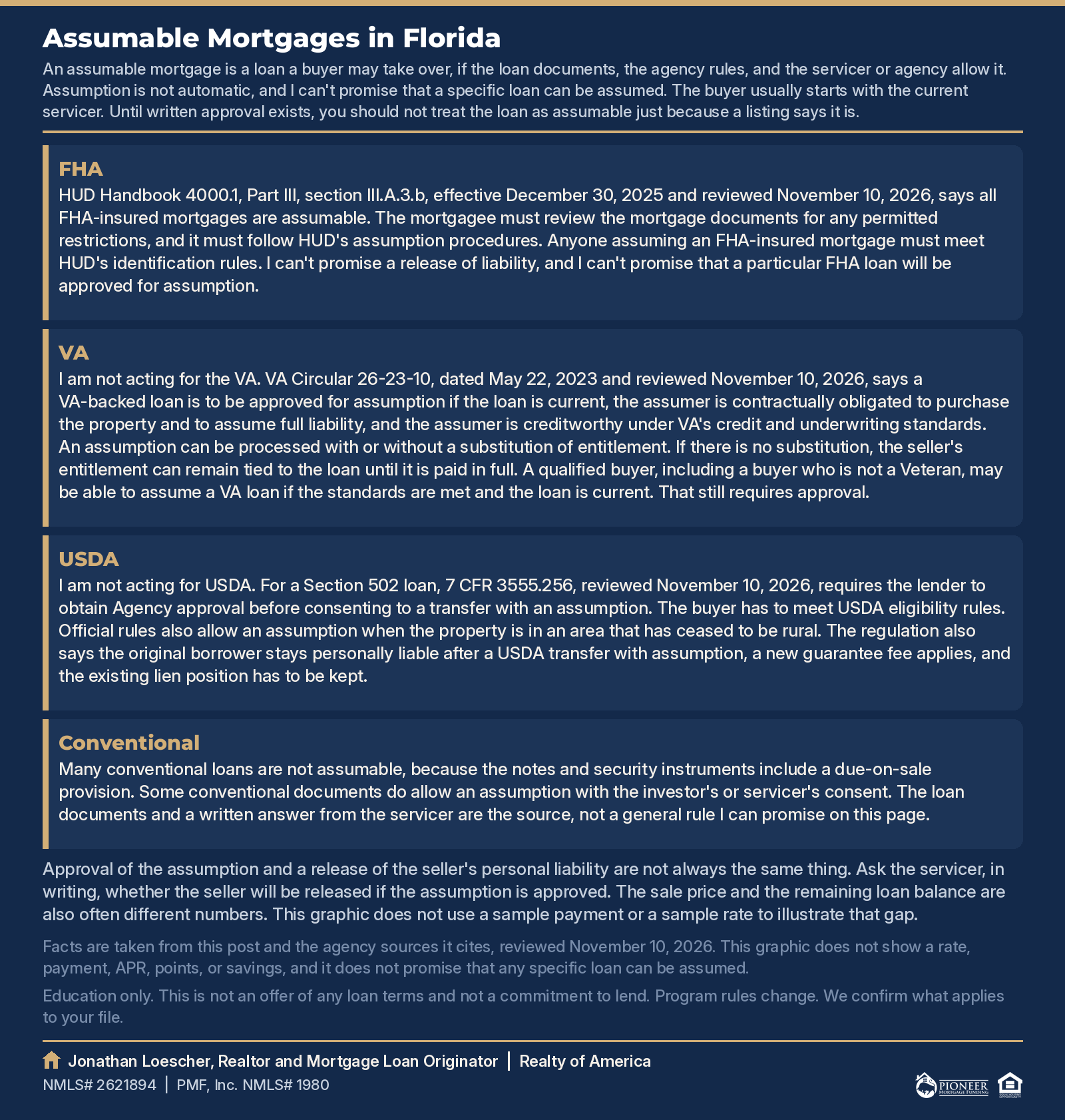
HUD Handbook 4000.1, Part III, section III.A.3.b, effective December 30, 2025 and reviewed on November 10, 2026, says all FHA-insured mortgages are assumable. The mortgagee must review the mortgage documents for any permitted restrictions, and it must follow HUD's assumption procedures, including notices about a possible release of personal liability. Anyone assuming an FHA-insured mortgage must meet HUD's identification rules, including a valid Social Security number or EIN, or a stated exception.
The servicer can charge a processing fee that is reasonable and customary under the handbook, plus certain actual third-party costs. I'm not restating handbook dollar caps here. The written fee disclosure from the servicer is the figure that matters on a live file. Credit review, when it is required, is part of that official process. I can't promise a release of liability, and I can't promise that a particular FHA loan will be approved for assumption.
How VA assumptions work
I'm a Mortgage Loan Originator, not an employee of the Department of Veterans Affairs, and I'm not acting for the VA. VA Circular 26-23-10, dated May 22, 2023 and reviewed on November 10, 2026, says a VA-guaranteed loan is to be approved for assumption if the loan is current, the assumer is contractually obligated to purchase the property and to assume full liability, and the assumer is creditworthy under VA's credit and underwriting standards.
An assumption can be processed with or without a substitution of entitlement. If the buyer is an eligible Veteran who intends to occupy the home and has enough entitlement, that buyer may substitute entitlement so the seller's entitlement can be restored. If there is no substitution of entitlement, the seller's entitlement can remain tied to the loan until it is paid in full, even if the seller is no longer responsible for the payment after an approved assumption. That tradeoff should be reviewed before anyone leans on a VA assumption as a simple exit.
A qualified buyer, including a buyer who is not a Veteran, may be able to assume a VA loan if the credit and income standards are met and the loan is current. That still requires approval. It is not automatic.
How USDA assumptions work
I'm not acting for USDA. For a Section 502 guaranteed loan, 7 CFR 3555.256, reviewed on November 10, 2026, requires the lender to obtain Agency approval before consenting to a transfer with an assumption. The buyer has to meet USDA eligibility rules, and the property has to meet site and dwelling standards or be brought to those standards. Official rules also allow an assumption when the property is in an area that has ceased to be rural.
The regulation also says the original borrower stays personally liable after a USDA transfer with assumption, a new guarantee fee applies, and the existing lien position has to be kept. Ask the servicer, in writing, how that applies to your loan. The broader purchase rules are in USDA loans near Tampa Bay.
What about a conventional loan?
Many conventional loans are not assumable, because the notes and security instruments include a due-on-sale provision. Some conventional documents do allow an assumption with the investor's or servicer's consent. The loan documents and a written answer from the servicer are the source, not a general rule I can promise on this page.
Common questions
If a listing says the loan is assumable, can I count on it?
No. Treat that as a lead to investigate. The servicer and the loan documents have to confirm it, and the buyer still has to be approved.
Does an approved assumption always release the seller?
No. Ask for a written answer on liability, and, on a VA loan, ask whether entitlement is being substituted. Those are separate questions from whether the buyer is allowed to take over the payments.
Can I assume a loan at the seller's payment without qualifying?
Generally, no, on the agency loans described here. The buyer is reviewed under the applicable credit and income standards, and approval is not automatic.
Assumptions are approved by the loan's servicer or agency, not by me, not every loan can be assumed, and approval is not guaranteed. I don't handle the assumption itself. If a buyer needs a second mortgage to cover the gap between the sale price and the assumed loan balance, I can originate a second-lien loan through PMF, Inc. Availability and terms vary by lender and property, and any loan approval is conditional until all underwriting conditions are met. If you want to look at a second-lien loan for that gap, you can start a loan application. You can also book a consultation to talk through the financing side.
This article is for education only. It is not an offer of any loan terms and not a commitment to lend. Program rules change. We confirm what applies to your file.
Jonathan Loescher, Realtor, Florida real estate license SL3546365, Realty of America. Jonathan Loescher, Mortgage Loan Originator, NMLS 2621894. Mortgage loans are originated through PMF, Inc., NMLS 1980, a Florida licensed Mortgage Broker. Real estate and mortgage services are provided by separate companies, and you don't have to use both. Verify licensing at www.nmlsconsumeraccess.org. Equal Housing Opportunity.
Education only. This is not a commitment to lend. All loans are subject to credit approval, underwriting, and property eligibility. Not all applicants will qualify. Any loan approval is conditional until all underwriting conditions are met. Programs, rates, terms and conditions may change without notice.
Common questions
- What is the average mortgage rate in Florida today?
- I don't post averages here. Rates move often, and your rate depends on your credit, loan program, down payment, property type, occupancy, and lock period. A published average can be far from what you'd get. Ask for a quote on your own scenario, dated, with the program and terms. Any loan approval is conditional until all underwriting conditions are met.
- How often do mortgage rates change?
- Often. Pricing can change daily, sometimes more than once, as bond markets move. Your quote also changes if your credit, down payment, program, or property changes. That's why quotes are dated. A rate lock holds pricing for a set period once you're under contract. Any loan approval is conditional until all underwriting conditions are met.
- What is a rate lock?
- A rate lock holds your rate and pricing for a set number of days while your loan closes. If the market rises, your lock holds. If closing slips past it, an extension may cost extra. Longer locks can cost more. Changes to your file, like the price or credit, can reprice it. Any loan approval is conditional until all underwriting conditions are met.
- What is the difference between pre-approval and pre-qualification?
- Pre-qualification is a conversation about income and credit. Pre-approval is a lender review of a file. Apply on this site for a second look even if you already have a letter from somewhere else.
- What Florida mortgage loan programs can a Mortgage Loan Originator offer?
- Common programs include conventional, FHA, VA, cash-out refinance, and non-QM loans like bank statement and DSCR. Some pair with down payment assistance. The right one depends on your file. You don't have to use both companies. Any loan approval is conditional until all underwriting conditions are met.
More Tampa Bay home and loan answers on Ask Jonathan.
Enjoying this? Make us a preferred source on Google.