
Mortgage Guide
Construction Loans in Florida for a New Tampa Bay Home
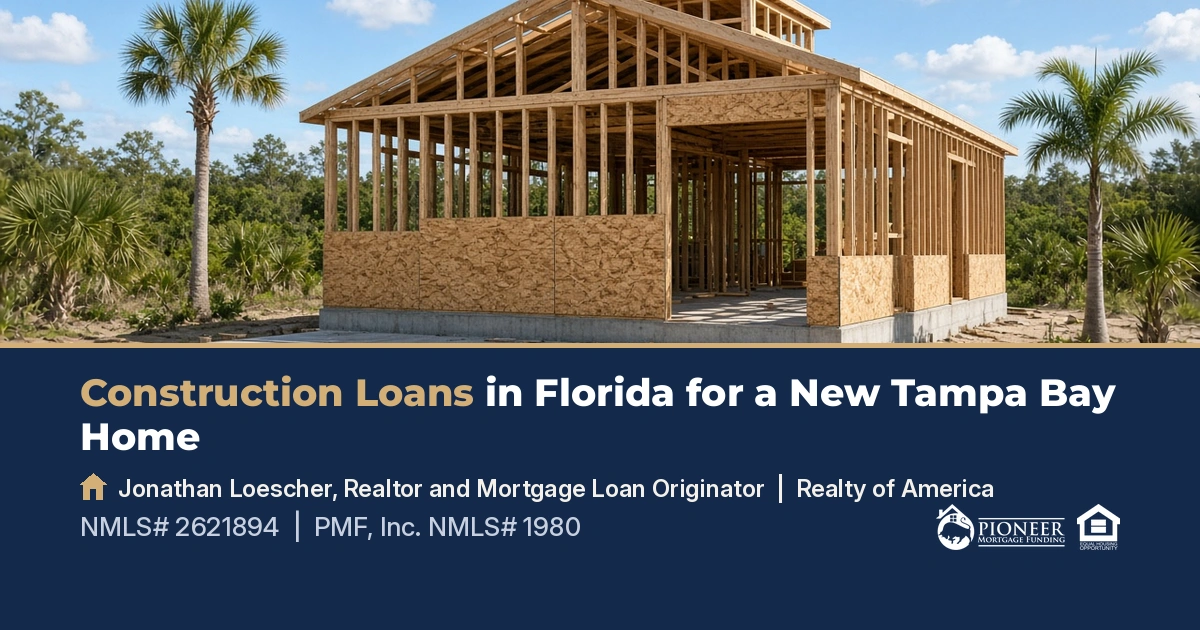
A construction loan funds a new home in stages as the work is done, instead of paying for a house that is already finished. In Tampa Bay, that usually means a one-time close or a two-close path, inspections before each draw, and a closer look at the builder contract. It is not automatic, and I can't promise a draw schedule or an approval from this article.
If you're comparing a finished new home rather than a house that still has to be built, start with advantages of buying a newly built home. That post is about buying a completed or nearly completed house. This one is about financing the build itself.
What a construction loan does
During the build, the lender usually advances money in draws after inspection of completed work, so the builder is paid for work in place rather than for the whole job up front. Plans, specifications, a builder contract, insurance, and an appraisal of the proposed home are part of the file. When the home is finished, the loan is either converted to a permanent mortgage or paid off by a new permanent loan, depending on the path you use.
A construction loan is not the same as a regular purchase of a completed spec home. If the house is already built and you're just closing a purchase, we look at a standard purchase loan. If the home isn't built yet, or it is only partly built, we look at construction financing.
One-time close versus two-close
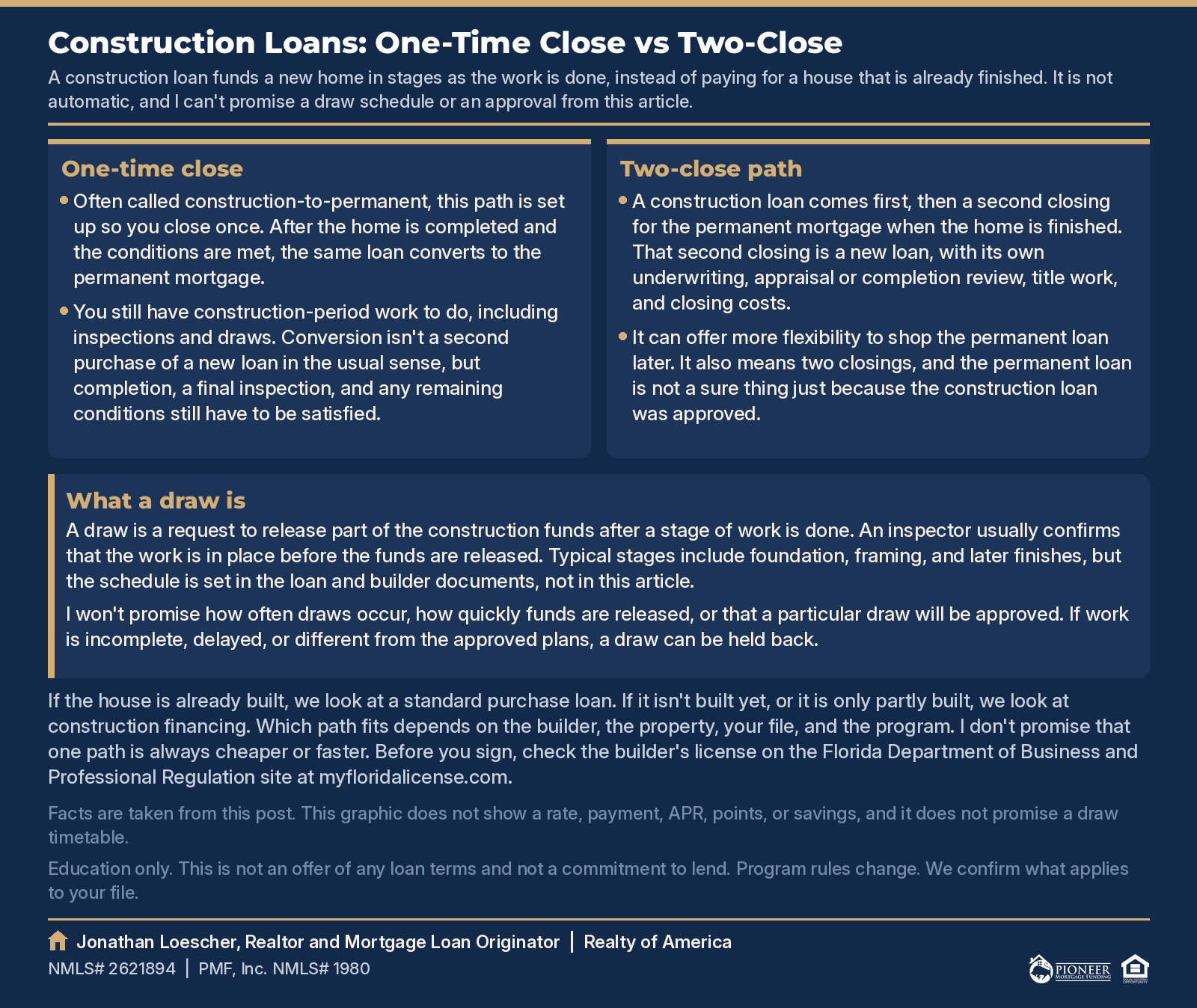
A one-time close loan, often called construction-to-permanent, is set up so you close once. After the home is completed and the conditions are met, the same loan converts to the permanent mortgage. You still have construction-period work to do, including inspections and draws. Conversion isn't a second purchase of a new loan in the usual sense, but completion, a final inspection, and any remaining conditions still have to be satisfied.
A two-close path uses a construction loan first, then a second closing for the permanent mortgage when the home is finished. That second closing is a new loan, with its own underwriting, appraisal or completion review, title work, and closing costs. It can offer more flexibility to shop the permanent loan later. It also means two closings, and the permanent loan is not guaranteed just because the construction loan was approved.
Which path fits depends on the builder, the property, your file, and the program. I compare them on the actual transaction. I don't promise that one path is always cheaper or faster.
What a draw is, in plain language
A draw is a request to release part of the construction funds after a stage of work is done. An inspector usually confirms that the work is in place before the funds are released. Typical stages include foundation, framing, and later finishes, but the schedule is set in the loan and builder documents, not in this article. I won't promise how often draws occur, how quickly funds are released, or that a particular draw will be approved.
If work is incomplete, delayed, or different from the approved plans, a draw can be held back. Contingency funds, change orders, and retainage, if the contract uses them, need to be understood before you sign. Bring the builder contract in early so we can see how the loan and the contract fit together.
Before you sign, check the builder's license on the Florida Department of Business and Professional Regulation site at myfloridalicense.com. Florida requires contractors to be licensed for the work they do, and a contract with an unlicensed contractor can't be enforced by that contractor.
New construction in Tampa Bay, including CDDs
Many new communities in Pasco, Hillsborough, and nearby counties sit inside a Community Development District. A CDD can levy assessments for infrastructure, and those assessments are part of the housing cost. On an initial sale, Florida law requires a specific contract disclosure. See what a CDD is and the CDD FAQ. A homestead exemption does not cancel a CDD assessment. I include the assessment when we qualify the file, once we have the lot's figures from the tax bill or the district documents. I don't quote assessment amounts here.
You can often choose your own mortgage professional rather than only the builder's preferred lender. Builder incentives tied to a preferred lender are usually a choice, not a requirement, so read the builder contract. I'll put the loan path and any incentive side by side so you can see the real cost, without quoting a rate in this article.
USDA, VA, and FHA construction questions
Some agency programs can be used when you are building, but the documentation, inspections, and property rules differ from a regular purchase, and not every file or lot fits. I won't cover the agency details in full here. Some agency programs have construction options, but not every lender offers them, and not every file or lot fits.
A VA construction file still has to follow VA property and fee rules, and I'm not acting for the VA, USDA, or FHA.
How I'd look at a construction file
I start with whether the home is already built. If it isn't, I look at the builder contract, the plans, the lot, and whether a one-time close or a two-close path is even available for that transaction. Then I compare a standard purchase, if a completed home is really what you're buying, against construction financing.
I can originate one-time-close and two-close construction loans through PMF, Inc. Availability, requirements, and terms vary by lender, builder, and project, and approval is not guaranteed. Any loan approval is conditional until all underwriting conditions are met.
As a Realtor with Realty of America, I can help you find the lot or the builder contract. As a Mortgage Loan Originator with PMF, Inc., I can help with the loan. PMF, Inc. is a mortgage broker that works with many wholesale lenders, so I can compare options for your situation. Rates and terms vary by lender, program and borrower, and I can't promise any particular rate or approval. You can use one or both. You don't have to use both.
Common questions
Is a construction loan the same as buying a brand-new house from a builder?
Not always. If the house is finished, it may be a regular purchase. If it still has to be built, or it is only partly built, it is usually construction financing.
Do I have to close twice?
Only on a two-close path. A one-time close is designed as a single closing that later converts to the permanent loan, after completion conditions are met. Neither path is guaranteed to be available on every file.
Can I use VA or FHA to build?
Some agency programs have construction options, but not every lender offers them, and not every file or lot fits.
Will the lender release money on a set timetable?
Don't count on a timetable from a blog. Draws follow inspections and the loan documents. I won't promise a release date.
This article is for education only. It is not an offer of any loan terms and not a commitment to lend. Program rules change. We confirm what applies to your file.
Jonathan Loescher, Realtor, Florida real estate license SL3546365, Realty of America. Jonathan Loescher, Mortgage Loan Originator, NMLS 2621894. Mortgage loans are originated through PMF, Inc., NMLS 1980, a Florida licensed Mortgage Broker. Real estate and mortgage services are provided by separate companies, and you don't have to use both. Verify licensing at www.nmlsconsumeraccess.org. Equal Housing Opportunity.
Education only. This is not a commitment to lend. All loans are subject to credit approval, underwriting, and property eligibility. Not all applicants will qualify. Any loan approval is conditional until all underwriting conditions are met. Programs, rates, terms and conditions may change without notice.
Common questions
- What is the average mortgage rate in Florida today?
- I don't post averages here. Rates move often, and your rate depends on your credit, loan program, down payment, property type, occupancy, and lock period. A published average can be far from what you'd get. Ask for a quote on your own scenario, dated, with the program and terms. Any loan approval is conditional until all underwriting conditions are met.
- How often do mortgage rates change?
- Often. Pricing can change daily, sometimes more than once, as bond markets move. Your quote also changes if your credit, down payment, program, or property changes. That's why quotes are dated. A rate lock holds pricing for a set period once you're under contract. Any loan approval is conditional until all underwriting conditions are met.
- What is a rate lock?
- A rate lock holds your rate and pricing for a set number of days while your loan closes. If the market rises, your lock holds. If closing slips past it, an extension may cost extra. Longer locks can cost more. Changes to your file, like the price or credit, can reprice it. Any loan approval is conditional until all underwriting conditions are met.
- What is the difference between pre-approval and pre-qualification?
- Pre-qualification is a conversation about income and credit. Pre-approval is a lender review of a file. Apply on this site for a second look even if you already have a letter from somewhere else.
- What Florida mortgage loan programs can a Mortgage Loan Originator offer?
- Common programs include conventional, FHA, VA, cash-out refinance, and non-QM loans like bank statement and DSCR. Some pair with down payment assistance. The right one depends on your file. You don't have to use both companies. Any loan approval is conditional until all underwriting conditions are met.
More Tampa Bay home and loan answers on Ask Jonathan.
Enjoying this? Make us a preferred source on Google.