
Mortgage Guide
Second-Home Loans vs Investment Property Loans in Florida
A second-home loan and an investment-property loan are not the same product with a different nickname. Occupancy is a written program test. If the way you will actually use the home does not match that test, the loan path can change, and a file can be reclassified. This article explains those occupancy rules. It is not tax advice, and it is not insurance advice.
For a short comparison, start with the live FAQ, What's the difference between a second home loan and an investment property loan. This guide goes further into underwriting. If the property will be a rental, also see DSCR loans in Florida and Tampa Bay short-term rental rules.
Why occupancy is reviewed so closely
Loan programs price risk, documentation, and eligibility differently when you will live in the home, use it part of the year, or hold it as a rental. That is why the application asks how you will occupy the property, and why the file has to match that answer. I can't treat a rental as a second home just because that label is more convenient, and I can't promise that a particular occupancy type will be available on every file.
Florida adds a practical wrinkle. Many buyers here want a second place near the water, and some also want to rent it when they are away. Whether that still fits a second-home program depends on the written rules, not on a marketing label. Local and association rental rules still have to be checked separately. Those rules do not, by themselves, decide the loan occupancy type.
What a second home has to be, on an agency file
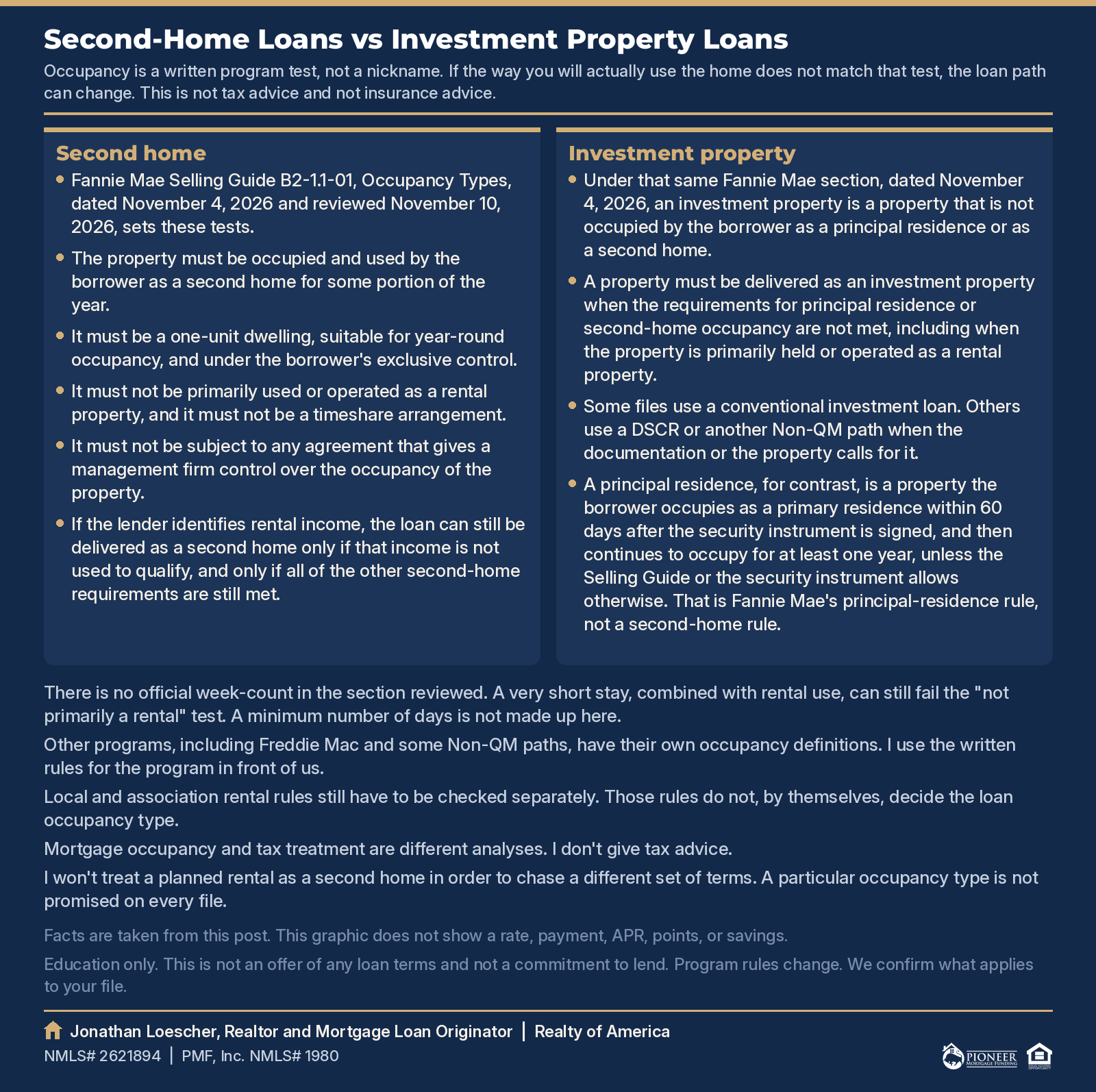
Fannie Mae Selling Guide B2-1.1-01, Occupancy Types, dated November 4, 2026 and reviewed for this article on November 10, 2026, sets specific tests for a second home. The property must be occupied and used by the borrower as a second home for some portion of the year. It must be a one-unit dwelling, suitable for year-round occupancy, and under the borrower's exclusive control. It must not be primarily used or operated as a rental property, and it must not be a timeshare arrangement. It also must not be subject to any agreement that gives a management firm control over the occupancy of the property.
The same section says that if the lender identifies rental income from the property, the loan can still be delivered as a second home only if that income is not used to qualify, and only if all of the other second-home requirements are still met, including the occupancy requirement. In other words, some rental activity is not automatically disqualifying, but using the rent to qualify, or giving a management firm control over when the home is occupied, can take the file out of the second-home box.
Other programs, including Freddie Mac and some Non-QM paths, have their own occupancy definitions. I use the written rules for the program in front of us, not a single nickname from an article.
What an investment property is
Under that same Fannie Mae section, dated November 4, 2026, an investment property is a property that is not occupied by the borrower as a principal residence or as a second home. A property must be delivered as an investment property when the requirements for principal residence or second-home occupancy are not met, including when the property is primarily held or operated as a rental property.
A principal residence, for contrast, is a property the borrower occupies as a primary residence within 60 days after the security instrument is signed, and then continues to occupy for at least one year, unless the Selling Guide or the security instrument allows otherwise. That 60-day and one-year framework is Fannie Mae's principal-residence rule. It is not a second-home rule, and it is not a promise about your move-in date.
If the home is truly a rental you won't live in, some files use a conventional investment loan. Others use a DSCR loan or another Non-QM mortgage. A Non-QM mortgage isn't a "qualified mortgage" under federal ability-to-repay rules, and it doesn't follow the documentation standards Fannie Mae and Freddie Mac use for a regular conventional loan. The lender still has to make a reasonable, good-faith determination, based on verified records, that you can repay. Loans made mainly for a business purpose, such as many DSCR loans on a rental you won't live in, generally fall outside the ability-to-repay rule. Whether a loan counts as business purpose depends on the facts, including whether you'll use the property yourself. See what a non-QM loan is and the conventional loan path.
Short-term rentals and Florida use
If you plan to list the home for short-term stays, start with the local and association rules, then with occupancy. A management agreement that controls who stays in the home, or a plan to operate the property primarily as a rental, can fail the second-home tests quoted above. In that case, the honest path is usually an investment loan, if a program fits the property and the file. I won't treat a planned rental as a second home in order to chase a different set of terms.
I don't give tax advice on second-home deductions, rental income, or homestead. Those questions belong with a tax professional. Homestead and occupancy for tax purposes are not the same analysis as occupancy for a mortgage program.
How I can help
I start with how you will actually use the home, then with whether that use fits a second-home program, a conventional investment loan, or a rental path such as DSCR. I can originate loans through PMF, Inc. Availability, occupancy rules, and terms vary by lender and property, and I can't promise an approval.
As a Realtor with Realty of America, I can help you find the property. As a Mortgage Loan Originator with PMF, Inc., I can help with the loan. PMF, Inc. is a mortgage broker that works with many wholesale lenders, so I can compare options for your situation. Rates and terms vary by lender, program and borrower, and I can't promise any particular rate or approval. You can use one or both. You don't have to use both.
Apply for a mortgage or book a consultation. Any loan approval is conditional until all underwriting conditions are met.
Common questions
Can I rent a second home when I am not there?
Sometimes, if the written second-home rules are still met. Under Fannie Mae's November 4, 2026 occupancy section, the home cannot be primarily used or operated as a rental, and a management firm cannot control occupancy. Identified rental income cannot be used to qualify if the loan is delivered as a second home. Other programs can be stricter. I confirm the rule that applies to your file.
What if I occupy the home only a few weeks a year?
Fannie Mae requires use as a second home for some portion of the year, exclusive control, and the other tests in that section. There is no official week-count in the section I reviewed. A very short stay, combined with rental use, can still fail the "not primarily a rental" test. I won't make up a minimum number of days here.
Is this the same as the tax definition of a second home?
Not necessarily. Mortgage occupancy and tax treatment are different analyses. I don't give tax advice.
This article is for education only. It is not an offer of any loan terms and not a commitment to lend. Program rules change. We confirm what applies to your file.
Jonathan Loescher, Realtor, Florida real estate license SL3546365, Realty of America. Jonathan Loescher, Mortgage Loan Originator, NMLS 2621894. Mortgage loans are originated through PMF, Inc., NMLS 1980, a Florida licensed Mortgage Broker. Real estate and mortgage services are provided by separate companies, and you don't have to use both. Verify licensing at www.nmlsconsumeraccess.org. Equal Housing Opportunity.
Education only. This is not a commitment to lend. All loans are subject to credit approval, underwriting, and property eligibility. Not all applicants will qualify. Any loan approval is conditional until all underwriting conditions are met. Programs, rates, terms and conditions may change without notice.
Common questions
- How does a DSCR loan help investors buy rentals in Tampa Bay?
- It qualifies a rental on its rent compared to the full payment, not your personal income. It's for business-purpose rentals only. Expect larger down payments and reserves. Check local rental rules first. Any loan approval is conditional until all underwriting conditions are met.
- What's the difference between a second home loan and an investment property loan?
- It depends on how you'll use the home. A second home is for your own use part of the year, and programs limit renting it. An investment property is bought to rent. Investment loans usually need a larger down payment and reserves and price higher. You certify occupancy at closing. Any loan approval is conditional until all underwriting conditions are met.
- How does a bank statement loan work for self-employed buyers in Tampa Bay?
- It uses deposits on your bank statements over many months, not tax returns, to figure income. It's a non-QM option for self-employed buyers whose returns understate cash flow. Expect larger down payments, reserves, and pricing that differs from conventional. Any loan approval is conditional until all underwriting conditions are met.
- Do I need a state license for a short-term rental in Florida?
- Yes, if you rent more than three times a year for stays under 30 days, or advertise it that way. You need a DBPR vacation rental license, either Condo or Dwelling, before you operate. Running without one is a second-degree misdemeanor. You'll also need tax registrations and any local permit your city or county requires.
- Can I do short-term rentals in Tampa?
- It depends on the zoning. A 2022 Tampa court decision upheld a violation for a two-night rental in a South Tampa RS-60 zone, reading the code to require weekly or longer stays there. Other zones may differ, and the code can change. Before you buy, check the parcel's zoning with the city, read any HOA or condo rules, and plan for the state license and taxes.
More Tampa Bay home and loan answers on Ask Jonathan.
Enjoying this? Make us a preferred source on Google.