

Mortgage Guide
Shopping Your Home Insurance Can Pay Off: A Tampa Bay Guide
Insurance Is a Bigger Part of Your Payment Than It Used to Be
When I go over a monthly payment with a buyer in Pinellas or Hillsborough, insurance is often the line that surprises them. And it's not just a Florida thing.
The September 2026 ICE Mortgage Monitor found property insurance now makes up 9.6% of the average mortgage holder's monthly payment. Ten years ago it was 7.5%.
The same report has some good news, though. And one simple habit stood out.
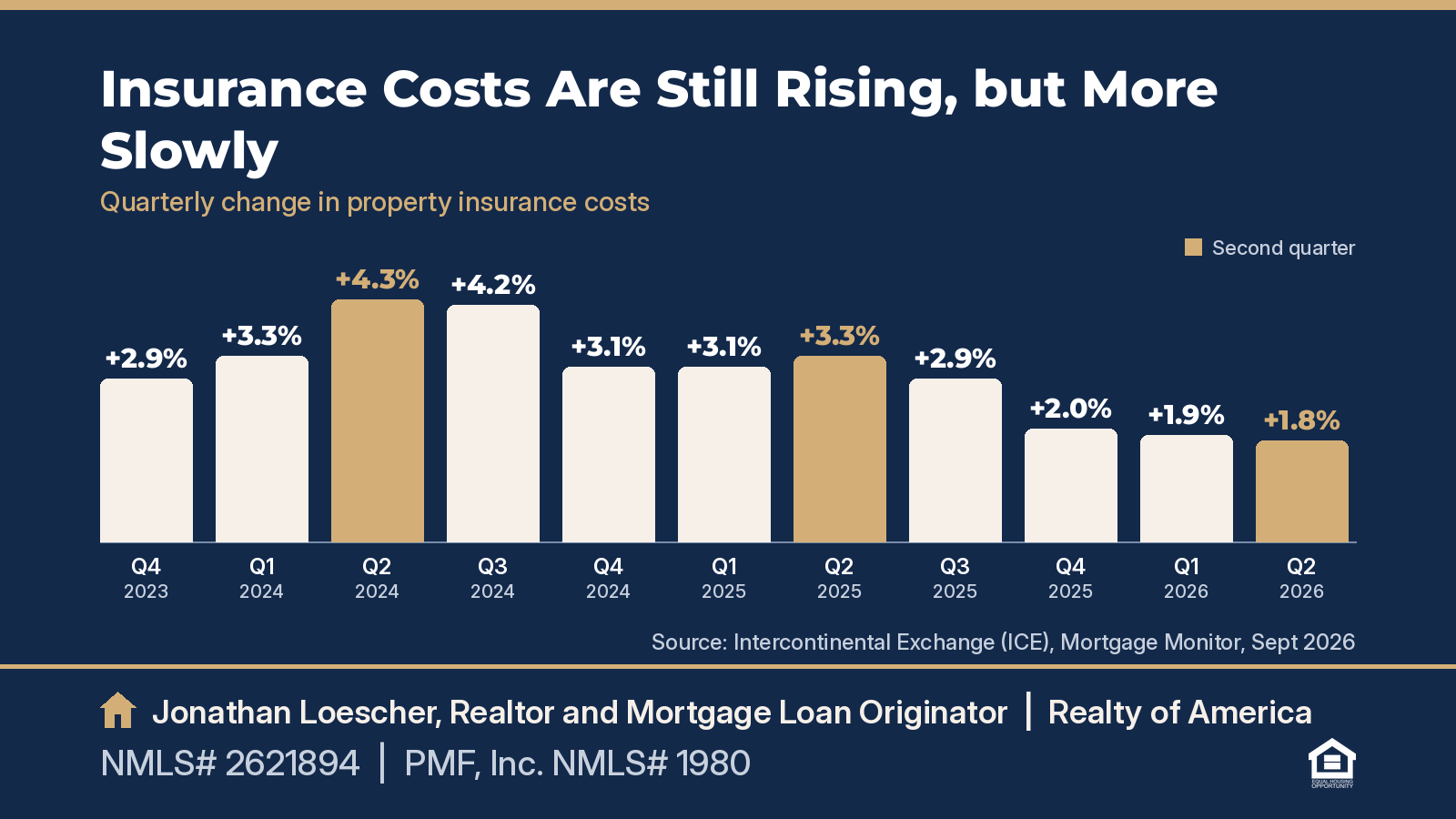
Insurance Costs Are Still Rising, but More Slowly
Nationally, insurance costs rose 8.7% over the 12 months ICE measured. That's still a lot, but it's down from a peak of 15.1% at the end of 2024.
The quarterly numbers make the slowdown easier to see:
- Q2 2024: up 4.3%
- Q2 2025: up 3.3%
- Q2 2026: up 1.8%
That 1.8% was the smallest quarterly increase since ICE started tracking the metric in 2023. Slower growth isn't the same as lower bills. Still, it's a better trend than we've seen in a while.
For the Florida side of the story, see my post Florida Homeowners Insurance in 2026: Is the Rate Relief Real?
Shopping Your Policy Can Pay Off
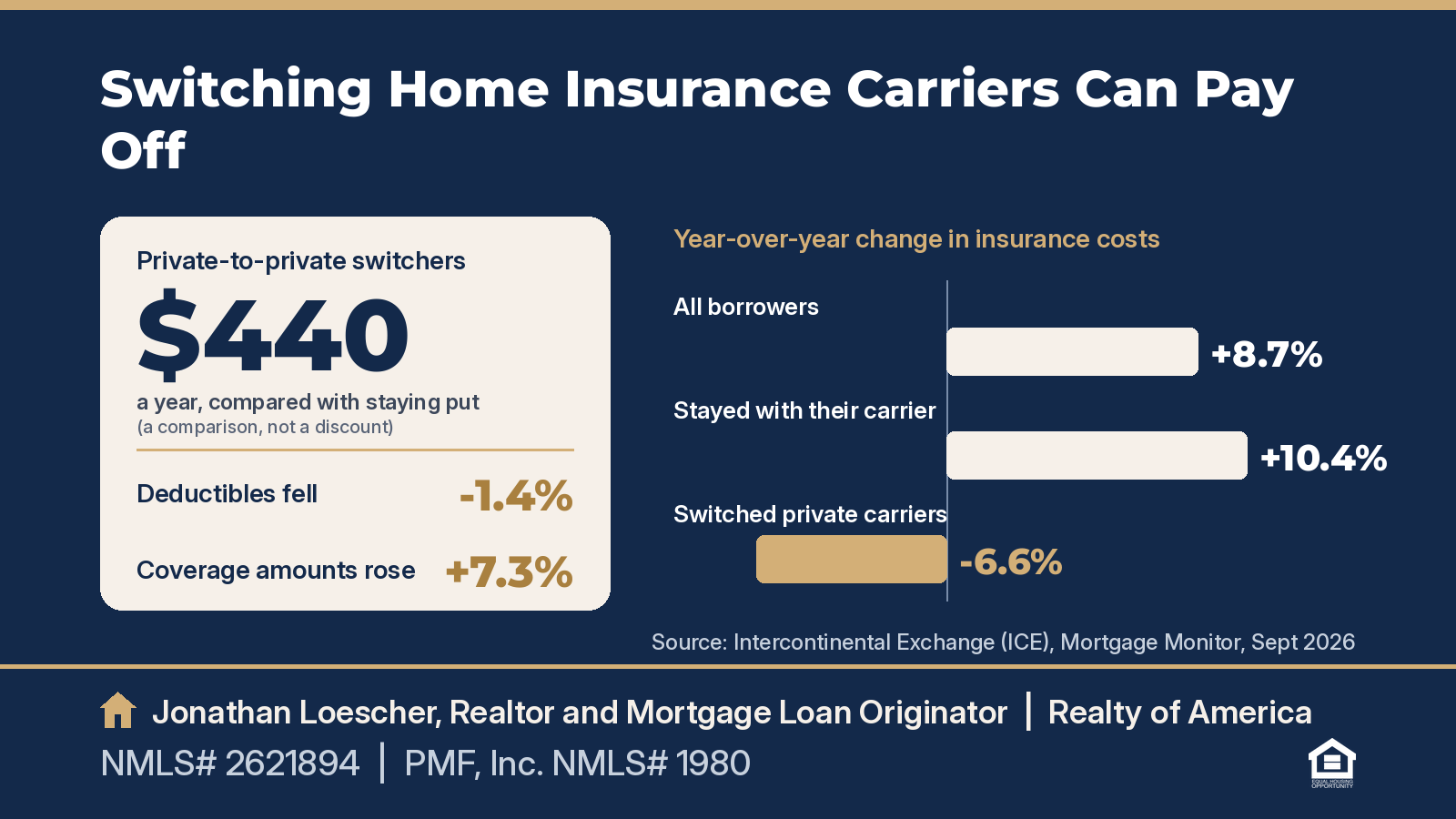
This is the part I want every homeowner to see. ICE compared people who switched from one private insurer to another with people who stayed put.
- Homeowners who stayed with the same carrier saw premiums rise 10.4%, on average.
- Homeowners who switched between private carriers saw premiums fall 6.6%, on average.
- Switchers also saw deductibles drop 1.4% and coverage amounts rise 7.3%, on average.
ICE says that gap is worth about $440 a year to the average mortgage holder who shopped. One thing to know: ICE calls that a comparison against what you'd have paid by staying, not a flat discount. Your own result can be higher, lower, or nothing at all.
There's a Florida wrinkle too. ICE found that homeowners moving off state-backed plans, mostly in Florida, saw payments rise 8.6% on average. Whether to leave a state-backed plan is a question for a licensed insurance agent. Just don't assume it'll lower your bill.
So what do I tell my clients?
- Get more than one quote. Ask an independent insurance agent to compare several carriers for you.
- Compare the whole policy. Look at the deductible, the coverage amount, and what's excluded, not just the price.
- Review it every renewal. Don't let it auto-renew without looking.
- Ask about credits. In my experience, roof age and a wind mitigation report can affect what Pinellas homeowners pay. I break that down in my Pinellas home insurance guide and my post on 4-point and wind mitigation inspections.
I'm not a licensed insurance agent, and I don't sell or recommend insurance policies. This is general information, not advice about your coverage. For quotes and coverage questions, talk with a licensed Florida insurance agent.
Newer Homes Can Cost Less to Insure
If you're buying, the age of the home matters. As reported by Chicago Agent Magazine, citing John Burns Research and Consulting, homes built in 2020 or later nationally may cost about 10% to 15% less to insure per square foot than homes built between 1980 and 2010.
It makes sense to me. In my experience, newer roofs, plumbing, and wiring can mean fewer claims. That's a national average, though, not a promise for any one house. In my experience, a newer home near the water can still carry a high flood or wind bill. When you browse homes, check the flood zone before you fall in love.
Get Quotes Before You Write an Offer
My best advice for buyers: get insurance quotes on a home while you're still deciding, not after. That number can change the payment you're comfortable with.
When we sit down to go over your budget, I'll build insurance into the full monthly picture. When you're ready, ask me about your options.
Let's Look at the Full Payment
If you're buying in Tampa Bay, book a consultation or start an application, and if you're still looking, you can browse homes first. We'll build your budget with insurance included.
I'm a Realtor with Realty of America and a Mortgage Loan Originator with PMF, Inc.
Mortgage loans are offered through PMF, Inc. NMLS# 1980. Real estate services are offered through Realty of America. They are separate companies, and you don't have to use both. Jonathan Loescher, Realtor (SL3546365), Realty of America. Jonathan Loescher, Mortgage Loan Originator, NMLS# 2621894. Equal Housing Opportunity. Education only. This is not a commitment to lend. All loans are subject to credit approval, underwriting, and property eligibility. Not all applicants will qualify. Any loan approval is conditional until all underwriting conditions are met. Programs, rates, terms and conditions may change without notice. Verify licensing at www.nmlsconsumeraccess.org.
Common questions
- How much can I save by switching home insurance?
- It varies. ICE found that people who switched between private carriers saw premiums fall 6.6% on average while those who stayed saw a 10.4% increase. ICE puts that gap at about $440 a year, as a comparison to staying put, not a discount. Savings aren't guaranteed, and leaving a state-backed plan raised payments 8.6% on average.
- Are home insurance costs still going up?
- Yes, but they're rising more slowly. ICE reported a 1.8% increase in the second quarter of 2026, the smallest quarterly rise since it began tracking the metric in 2023.
- Is a new home cheaper to insure?
- Often, but not always. Chicago Agent Magazine reported that, according to John Burns Research and Consulting, homes built in 2020 or later may cost about 10% to 15% less to insure per square foot, nationally, than homes built between 1980 and 2010. Location and flood risk can still affect the cost.
- When should I shop for insurance?
- Shop before you make an offer, and again at every renewal.
- Where is Bayou Club in Seminole, Florida?
- Bayou Club Estates is a gated golf community on the Seminole and Largo edge of Pinellas County. Most listings use a Seminole city and ZIP 33777. The gate is off Belcher Road. It is not in Seminole County. Open the Bayou Club homes for sale search for live listings.
More Tampa Bay home and loan answers on Ask Jonathan.
Enjoying this? Make us a preferred source on Google.
Have a question about how this applies to your home or loan?
Book a Call