
Mortgage Guide
ARM Loans in Tampa Bay: How Today's ARMs Work and Who They Fit
More buyers are asking me about adjustable-rate mortgages this fall. I get why. When fixed rates are high, an ARM's lower starting rate can make a payment work that otherwise wouldn't.
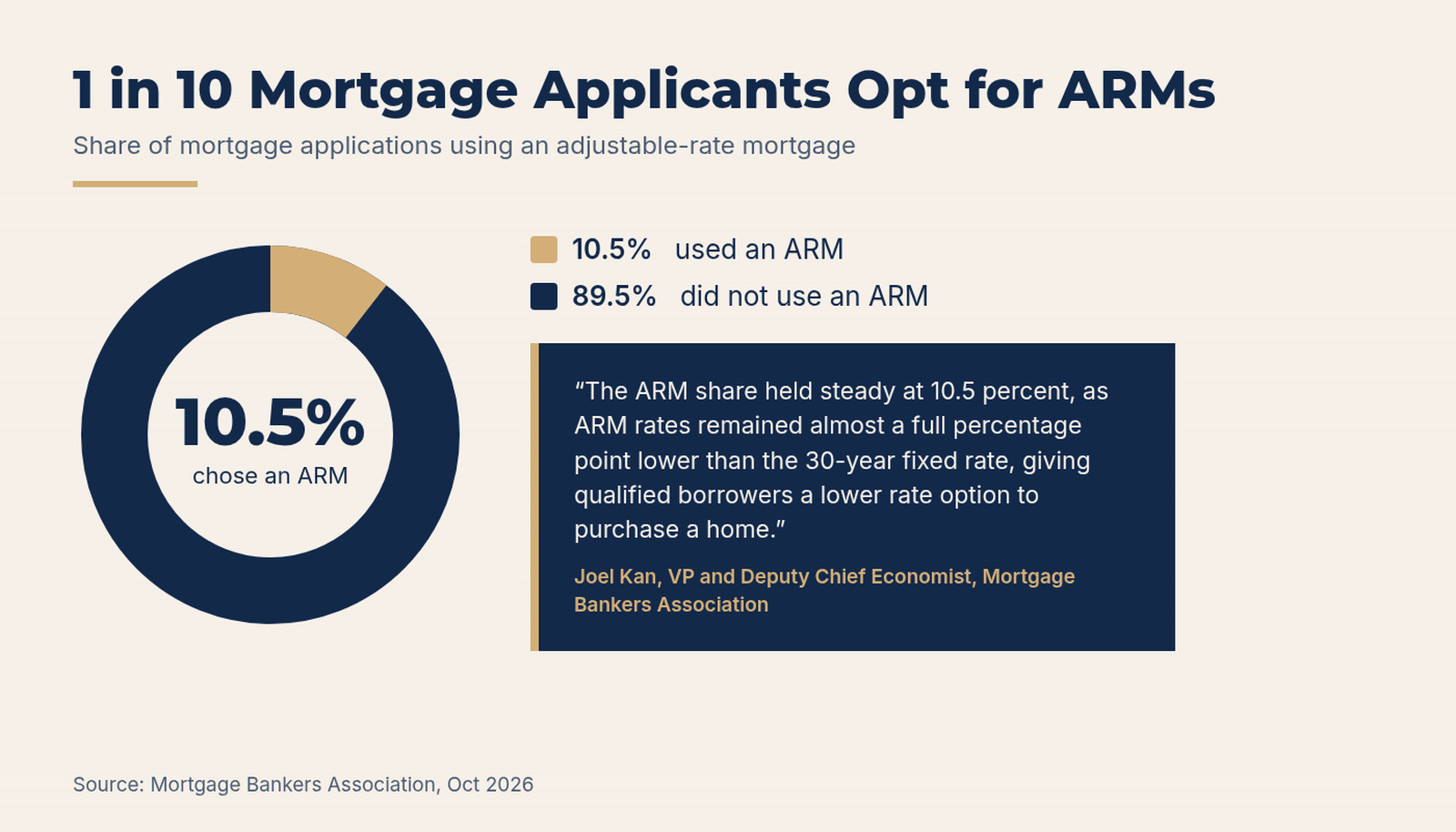
As of the week ending October 16, 2026, ARMs were 10.5% of all mortgage applications, according to the industry's weekly mortgage application survey released October 21. The survey's deputy chief economist, Joel Kan, put it this way: "The ARM share held steady at 10.5 percent, as ARM rates remained almost a full percentage point lower than the 30-year fixed rate, giving qualified borrowers a lower rate option to purchase a home."
The lower rate is just the start. Here's how an ARM actually works, what happens when it resets, and who I think it fits here in Pinellas and Hillsborough.
How a 5/6 ARM works
People still say "5/1" out of habit. Most conventional ARMs I see today are written differently. The first number is the years your starting rate is fixed: 5, 7 or 10. The "6" means the rate can change every six months after that. So a 5/6 is fixed for five years, then adjusts twice a year.
Some government-backed ARMs, like FHA, still adjust once a year after the fixed period. Always check how often the loan you're quoted can change.
During the fixed period, your rate and principal-and-interest payment don't move. ARM starting rates are often lower than 30-year fixed rates, which is the whole appeal.
After year five, your new rate is set by two numbers:
- The index. A market interest rate that moves with general conditions. You don't control it. On most conventional ARMs today, it's the 30-day average SOFR, the Secured Overnight Financing Rate, published by the New York Fed.
- The margin. A fixed number of percentage points added to the index. It's set in your loan agreement and doesn't change after closing. You can shop and compare it, like any other rate.
Index plus margin is called the fully indexed rate. That becomes your new rate, but only within the limits of your caps.
The three caps that protect you
- Initial adjustment cap. How far the rate can move at the first reset. Two or five percentage points is common.
- Periodic (subsequent) cap. How far it can move at each later reset. One point is common on six-month ARMs. On ARMs that adjust once a year, one or two points is common.
- Lifetime cap. How far it can ever rise above the starting rate. Five points is common.
Caps are written as three numbers. On standard conventional ARMs, a 5/6 usually has 2/1/5 caps. A 7/6 or 10/6 usually has 5/1/5 caps. That means a longer fixed period can come with a bigger possible jump at the first reset. Two loans can have the same starting rate and very different caps, so compare them side by side.
What ARMs look like today
I'm a Mortgage Loan Originator at a mortgage broker, so I don't have just one menu. I compare programs from several lenders and match each client with the best fit. Here's what I'm seeing:
- Conventional ARMs. Most lenders I work with offer 5/6, 7/6 and 10/6 options on SOFR. Some also offer them inside affordable lending programs.
- FHA ARMs. Some lenders I work with offer an FHA 5/1 for buyers who need a smaller down payment.
- Larger loans. Above the conforming limit, some lenders offer jumbo or non-QM ARMs, often with a 7/6 or 10/6 structure.
- Non-QM ARMs. Some lenders offer 5/6, 7/6 and 10/6 non-QM ARMs that document income in other ways, like bank statements, 1099s or assets. Some allow interest-only payments for a set period. Non-QM loans usually carry higher rates and fees. They usually need bigger down payments and more reserves than conventional loans. On an interest-only loan, you pay nothing toward principal during the interest-only period. Your payment rises, sometimes sharply, when that period ends. Not everyone will qualify.
Interest-only ARMs aren't Qualified Mortgages. They're non-QM loans. I explain why that matters in the 2008 section below. Credit score, down payment, property type and occupancy rules vary by lender and program. Investment properties, condos and 2 to 4 unit homes can have tighter limits. Pricing changes daily, so I'll price your own file when you're ready.
A worked example (hypothetical)
Hypothetical example, not an offer, rate quote or forecast. Rates may change and may not be available at commitment or closing.
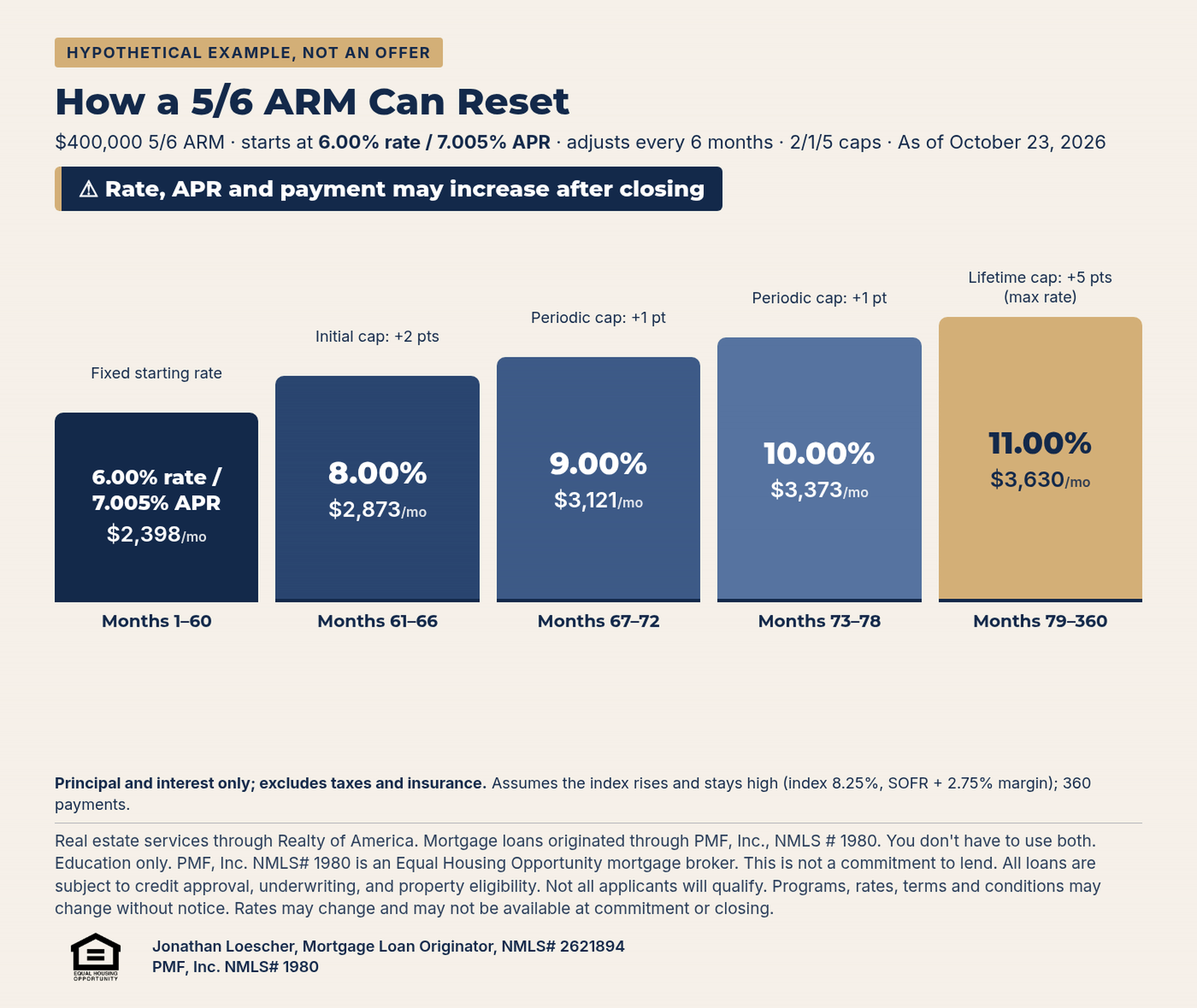
Say you buy a $500,000 home with a 20% down payment ($100,000). You borrow $400,000 on a 30-year 5/6 adjustable-rate mortgage, with 360 monthly payments. As of October 23, 2026, the starting rate is 6.00% for the first 60 months, 7.005% APR. The APR may increase after closing. After that, the rate can change every six months. It's based on the 30-day average SOFR index plus a 2.75% margin, with 2/1/5 caps. The rate and payment may increase.
Mortgage rates change daily. As of October 23, 2026, the example rate was 6.00% (7.005% APR), assuming 2.799 discount points (about $11,196) plus other estimated loan costs paid at closing. The APR may increase after closing. This pricing is for a primary-residence purchase with a 760 credit score and a 30-day rate lock. Rates and points may change and may not be available at commitment or closing.
For this example, I assume the index rises to 8.25% by the first reset and stays there. Index plus margin is then 11.00%, so the caps hold the rate back at every step.
- Years 1 to 5: about $2,398 a month in principal and interest. After five years you'd owe about $372,200.
- Months 61 to 66: the initial cap is 2 points, so the rate can only go to 8.00%. Your payment becomes about $2,873.
- Months 67 to 72: the periodic cap is 1 point, so the rate goes to 9.00%. The payment rises to about $3,121.
- Months 73 to 78: another 1-point step, to 10.00%. The payment rises to about $3,373.
- Months 79 to 360: the rate hits the 11.00% ceiling. The lifetime cap is 5 points, so it can never go higher. The payment is about $3,630 for the rest of the loan.
These are principal and interest only. They don't include property taxes or homeowners and flood insurance, so your actual payment will be higher.
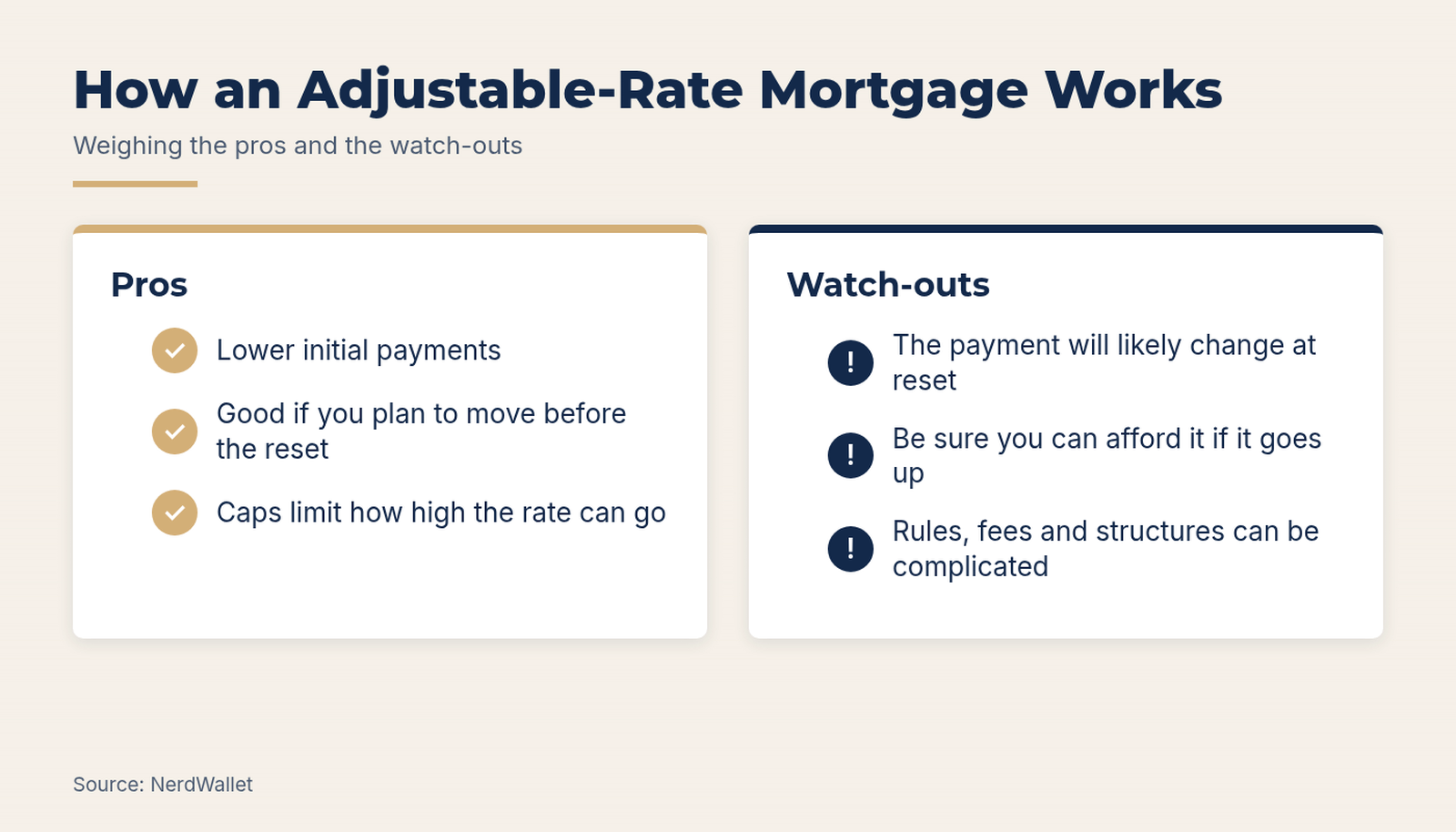
It can work the other way too. If the index falls, your rate can drop at reset, subject to the same caps and any floor in your loan. I always ask clients one question: could you handle the worst-case payment if you had to?
Hypothetical example, not an offer. As of October 23, 2026, 6.00% starting rate, 7.005% APR. Rate and payment may increase. The APR may increase after closing. Payments are principal and interest only and exclude taxes and insurance. Rates may change and may not be available at commitment or closing.
Your options when the rate resets
A reset isn't a cliff. You'll usually have a few paths:
- Keep it. If the new payment fits your budget, you can do nothing.
- Refinance. Into a fixed rate, or into another ARM with a new fixed period. Remember, a refinance is a brand-new loan. You have to qualify again, so keep your credit and debts in good shape.
- Sell. Some ARM borrowers plan from day one to move before the reset.
- Pay it down. Paying extra principal, or a lump sum, lowers the balance the new rate applies to. On many ARMs that lowers the payment at the next reset. Confirm how your loan recalculates.
If you ever have trouble with the payment, call your servicer early and ask about options. A HUD-approved housing counselor can also help.
Who an ARM can fit
- Buyers who expect to move in a few years. In my experience here, that can include military families with MacDill orders, medical residents, or anyone who sees a job change coming.
- Buyers who will pay down the loan quickly. For example, someone selling another property or expecting a bonus or inheritance.
- Buyers with room in the budget. If you could handle the capped worst-case payment, the lower early payment is a real benefit.
Who it doesn't fit
- Buyers who want a forever home and a payment that never changes. A fixed rate gives you that certainty.
- Buyers who are already stretched. In Tampa Bay, insurance, flood coverage and condo assessments can rise too. An ARM adds one more number that can move.
- Anyone counting on refinancing later. Rates, home values and your own finances can all change. Plans don't always work out.
My reading: an ARM is a tool for a specific plan, not a way to stretch into a house you can't afford at the fixed rate. If you're buying a Pinellas condo, also read my guide to vetting reserves, SIRS and assessments. Assessments count in your monthly budget. And if insurance is part of your math, see my Pinellas insurance guide.
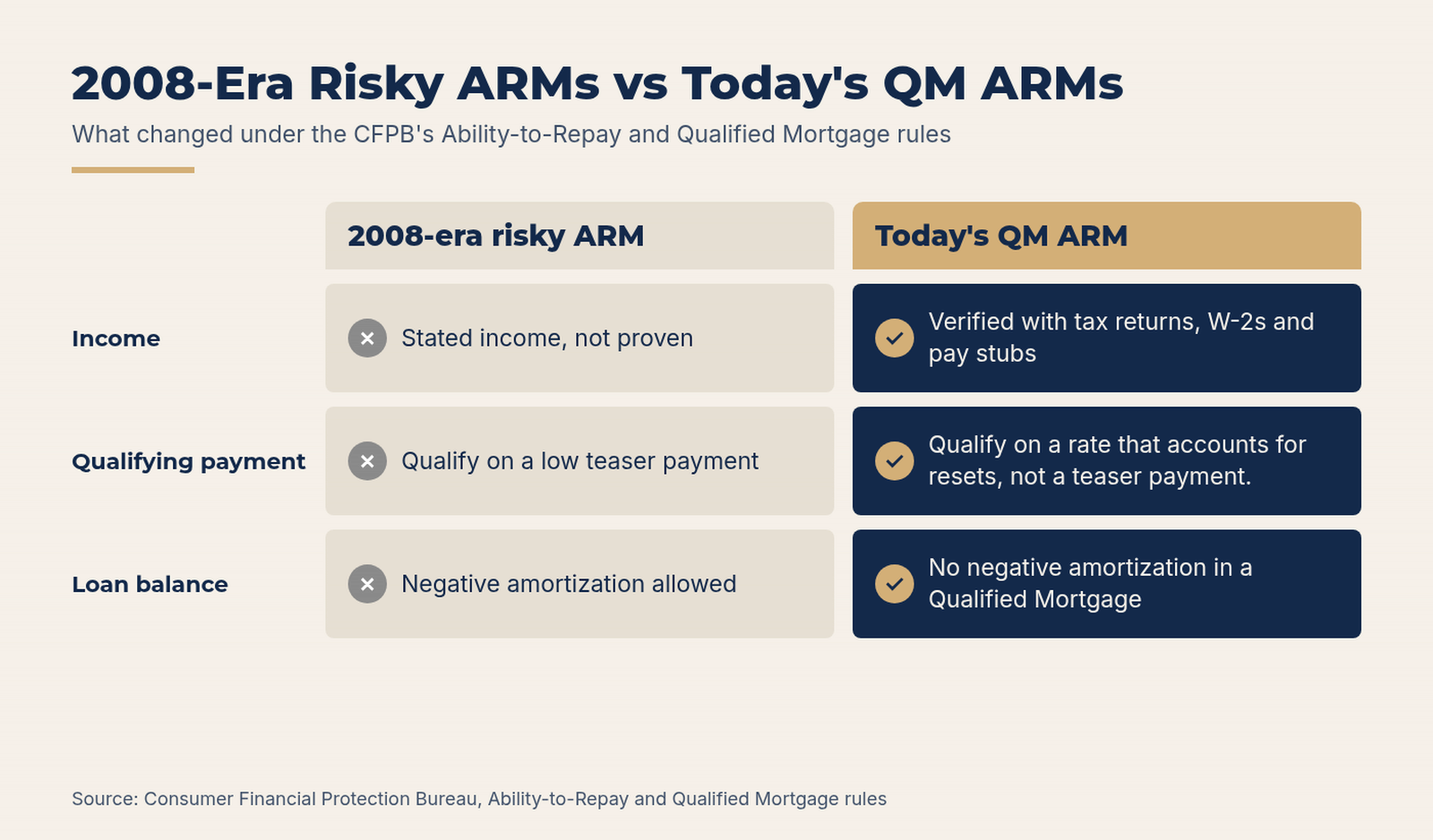
Why today's ARMs aren't 2008's ARMs
ARMs got a bad reputation in the run-up to 2008. Some loans let borrowers qualify on a tiny starting payment, without proving income, and some let the balance grow. The rules are different now. Everything in this section applies to Qualified Mortgages. Non-QM ARMs, including interest-only ones, still have to meet Ability-to-Repay, but they fall outside the QM limits.
- Ability-to-Repay. Under the CFPB's Ability-to-Repay rule, a lender must make a reasonable, good-faith determination that you can repay. It must verify your income or assets with third-party records like tax returns, W-2s and pay stubs, and it must consider your debts and credit history.
- No qualifying on a teaser payment. For an ARM, the lender has to use the fully indexed rate or the starting rate, whichever is higher. You can't qualify on a low introductory payment alone.
- Qualified Mortgage limits. For a general Qualified Mortgage, the lender must underwrite using the maximum rate that can apply in the first five years. QM loans can't have negative amortization, interest-only periods or terms over 30 years. The CFPB explains the Qualified Mortgage rules here.
Those rules don't make an ARM right for everyone. They do mean you'll be qualified on a realistic payment, not a teaser.
Run the numbers on your own loan
I can put a fixed rate and an ARM side by side for your price range. That includes the starting payment, the caps and the worst-case payment, so you can decide with your eyes open. Rates move and depend on your own file. For more on rate context, see my post on mortgage rates and the Fed in Tampa Bay. If your credit file is thin, read how renters build credit history.
When you're ready, you can apply for a loan or book a consultation. I can help on the loan side, the real estate side, or both.
Education, not a rate quote or a commitment to lend. Sources: CFPB on index and margin, CFPB on rate caps, standard conventional SOFR ARM terms, a consumer finance guide to ARM pros and cons. All checked October 23, 2026.
Jonathan Loescher, Tampa Bay Realtor and Mortgage Loan Originator (SL3546365, NMLS 2621894).
Real estate services through Realty of America. Mortgage loans originated through PMF, Inc., NMLS # 1980. You don't have to use both. Education only. PMF, Inc. NMLS# 1980 is an Equal Housing Opportunity mortgage broker. This is not a commitment to lend. All loans are subject to credit approval, underwriting, and property eligibility. Not all applicants will qualify. Programs, rates, terms and conditions may change without notice.
Common questions
- Where is Bayou Club in Seminole, Florida?
- Bayou Club Estates is a gated golf community on the Seminole and Largo edge of Pinellas County. Most listings use a Seminole city and ZIP 33777. The gate is off Belcher Road. It is not in Seminole County. Open the Bayou Club homes for sale search for live listings.
- Where is Oakhurst Shores in Seminole, Florida?
- Oakhurst Shores is a west Seminole neighborhood in Pinellas County near Oakhurst Drive, Grove Street, and Boca Ciega Bay. Most sale files use ZIP 33772. It is not in Seminole County. Many homes may have water frontage, however being in this community does not guarantee water frontage. Search live files on the Oakhurst Shores homes for sale page.
- Where is Yacht Club Estates in Seminole, Florida?
- Yacht Club Estates is a Seminole neighborhood in Pinellas County. Listings cluster on streets such as Portside Drive and Commodore Drive in ZIP 33776. It is not Seminole County. The yacht-club name does not guarantee a slip or dock. Search live files on the Yacht Club Estates homes for sale page.
- What are seller closing costs in Florida?
- Seller closing costs in Florida are the checks that come off your sale proceeds: mortgage payoff, title, prorated taxes, HOA or CDD transfer items, negotiated brokerage compensation, and any credits you promise in the contract. There is no single statewide percent that fits every Pinellas file. I will run a net sheet through Realty of America so you see your numbers, not an online estimate.
- What Pinellas County Realtor service area does Jonathan Loescher cover?
- I serve all 24 Pinellas County municipalities and greater Tampa Bay as a Florida Realtor (SL3546365, Realty of America) and Mortgage Loan Originator (NMLS 2621894, PMF, Inc.). That includes Clearwater, St. Petersburg, Largo, Seminole, Belleair, Gulfport, Safety Harbor, Indian Shores, Tampa, and the surrounding communities. Neighborhood guides live on jonathanloescher.com/communities.
More Tampa Bay home and loan answers on Ask Jonathan.
Enjoying this? Make us a preferred source on Google.
Have a question about how this applies to your home or loan?
Book a Call