
Mortgage Guide
A Closed-End Second Mortgage vs a HELOC

A closed-end second mortgage is a fixed loan amount secured by your home, usually behind a first mortgage. A HELOC is a revolving line of credit against that same equity. Both are typically junior liens, but they don't work the same way after closing.
This article is about that difference. It is not another guide to a first-lien home equity line. For that product, use the first-lien home equity line guide, the first-lien home equity line programs page, and the first-lien HELOC FAQ.
What is a closed-end second mortgage?
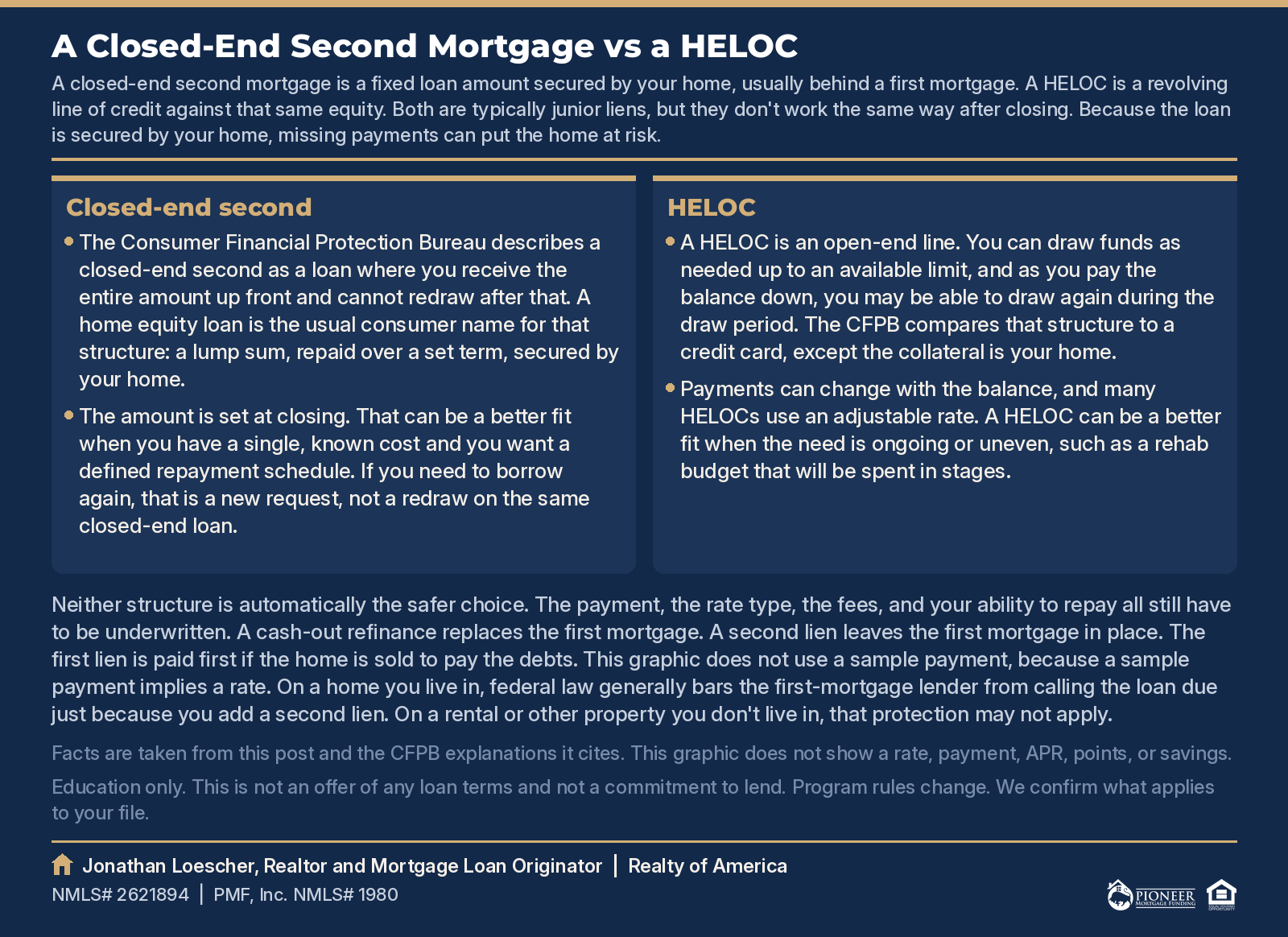
The Consumer Financial Protection Bureau describes a closed-end second as a loan where you receive the entire amount up front and cannot redraw after that. A home equity loan is the usual consumer name for that structure: a lump sum, repaid over a set term, secured by your home.
The "second" or "junior" part matters if the home is sold to pay the debts. The first lien is paid first. If the equity is not enough to cover both loans, the second-lien lender may not be paid in full. That extra risk is one reason a second mortgage can cost more than a first lien. I'm not quoting rates here.
Because the loan is secured by your home, missing payments can put the home at risk. The CFPB makes that point clearly, and it applies to both a closed-end second and a HELOC.
How is a HELOC different?
A HELOC is an open-end line. You can draw funds as needed up to an available limit, and as you pay the balance down, you may be able to draw again during the draw period. The CFPB compares that structure to a credit card, except the collateral is your home. Payments can change with the balance, and many HELOCs use an adjustable rate.
A closed-end second does not replenish. The amount is set at closing. That can be a better fit when you have a single, known cost and you want a defined repayment schedule. A HELOC can be a better fit when the need is ongoing or uneven, such as a rehab budget that will be spent in stages. Neither structure is automatically the safer choice. The payment, the rate type, the fees, and your ability to repay all still have to be underwritten.
This comparison is not a cash-out refinance article. A cash-out refinance replaces the first mortgage. A second lien leaves the first mortgage in place.
A closed-end second also shows up at purchase, sometimes as a "piggyback" behind a new first mortgage, when a buyer wants to finance part of the price without changing the first-lien program. That structure has its own combined-lien and qualifying rules. I'm not restating a combined loan-to-value cap here. Whether it helps depends on the first-lien program, the property, and the rest of the file, not on the nickname.
Either way, a second lien still needs an application, a title review, and usually an appraisal or other valuation the program accepts. On a home you live in, federal law generally bars the first-mortgage lender from calling the loan due just because you add a second lien. On a rental or other property you don't live in, that protection may not apply, so we read the first mortgage's terms before a second lien is placed.
Where a second lien shows up on an investor file
Some rental files use a second lien as well, including a DSCR second in certain cases. The documentation can be a standard rental qualification, or, on some Non-QM seconds, a bank statement or a profit and loss statement. Those are general documentation options, not a menu of named programs. I can originate DSCR second liens through PMF, Inc. Availability and terms vary by lender and property.
If the first question is the rental itself, start with DSCR loans in Florida. For the wider documentation context, see what a non-QM loan is. A second lien on a rental still uses the property as collateral, and it still does not guarantee the rent you will collect.
What to compare besides the label
Ask whether the amount is a lump sum or a line you can redraw. Ask how the payment is calculated, and whether it can change. Ask what fees are charged to open or to draw the account. On a rental, ask whether the first mortgage's terms limit adding a second lien. Ask how a payoff works if you sell or refinance later.
I won't use a sample payment to illustrate the difference, because a sample payment implies a rate. The right comparison is the written loan estimate or program disclosures for the actual file, plus the CFPB's consumer explanations of home equity loans, HELOCs, and junior liens.
Common questions
Is a home equity loan the same thing as a closed-end second?
Often, yes, when the home equity loan is in junior position behind a first mortgage. The CFPB treats a home equity loan as a lump-sum loan against your equity, and it treats that structure as a common closed-end second.
Can a second mortgage be in first-lien position?
The everyday name "second mortgage" refers to lien position, not to the fact that it is your second time borrowing. A home equity line can also be originated in first-lien position. That is the product I already covered in the first-lien guide, not this comparison.
Does a closed-end second let me draw again later?
No. The amount is disbursed up front, and you repay that loan. If you need to borrow again, that is a new request, not a redraw on the same closed-end loan.
I can originate closed-end seconds, second-lien home equity lines and first-lien home equity lines through PMF, Inc. Availability and terms vary by lender and property, and approval is not guaranteed. Any loan approval is conditional until all underwriting conditions are met. If you want to look at one of these, you can start a loan application. If you want to talk through the difference first, book a consultation.
This article is for education only. It is not an offer of any loan terms and not a commitment to lend. Program rules change. We confirm what applies to your file.
Jonathan Loescher, Realtor, Florida real estate license SL3546365, Realty of America. Jonathan Loescher, Mortgage Loan Originator, NMLS 2621894. Mortgage loans are originated through PMF, Inc., NMLS 1980, a Florida licensed Mortgage Broker. Real estate and mortgage services are provided by separate companies, and you don't have to use both. Verify licensing at www.nmlsconsumeraccess.org. Equal Housing Opportunity.
Education only. This is not a commitment to lend. All loans are subject to credit approval, underwriting, and property eligibility. Not all applicants will qualify. Any loan approval is conditional until all underwriting conditions are met. Programs, rates, terms and conditions may change without notice.
Common questions
- What is the average mortgage rate in Florida today?
- I don't post averages here. Rates move often, and your rate depends on your credit, loan program, down payment, property type, occupancy, and lock period. A published average can be far from what you'd get. Ask for a quote on your own scenario, dated, with the program and terms. Any loan approval is conditional until all underwriting conditions are met.
- How often do mortgage rates change?
- Often. Pricing can change daily, sometimes more than once, as bond markets move. Your quote also changes if your credit, down payment, program, or property changes. That's why quotes are dated. A rate lock holds pricing for a set period once you're under contract. Any loan approval is conditional until all underwriting conditions are met.
- What is a rate lock?
- A rate lock holds your rate and pricing for a set number of days while your loan closes. If the market rises, your lock holds. If closing slips past it, an extension may cost extra. Longer locks can cost more. Changes to your file, like the price or credit, can reprice it. Any loan approval is conditional until all underwriting conditions are met.
- What is the difference between pre-approval and pre-qualification?
- Pre-qualification is a conversation about income and credit. Pre-approval is a lender review of a file. Apply on this site for a second look even if you already have a letter from somewhere else.
- What Florida mortgage loan programs can a Mortgage Loan Originator offer?
- Common programs include conventional, FHA, VA, cash-out refinance, and non-QM loans like bank statement and DSCR. Some pair with down payment assistance. The right one depends on your file. You don't have to use both companies. Any loan approval is conditional until all underwriting conditions are met.
More Tampa Bay home and loan answers on Ask Jonathan.
Enjoying this? Make us a preferred source on Google.