
Mortgage Guide
VA Loans in Florida: Entitlement, Funding Fee, and Condos
A VA loan is a mortgage guaranteed by the U.S. Department of Veterans Affairs for eligible Veterans, service members, and some surviving spouses. In Florida, the usual questions are entitlement, the funding fee, whether a condo building is approved, and which purchase costs a buyer cannot pay. Eligibility still has to be confirmed, and the lender still has to approve the file.
I'm a Mortgage Loan Originator, not an employee of the Department of Veterans Affairs, and I'm not acting for the VA. VA determines eligibility and entitlement. This article is education only. For the program page, start with VA loan programs. For a short Pinellas-focused answer, see how VA loans work in Pinellas County. This post is the longer Florida guide and does not replace that FAQ.
What entitlement means, and why your COE matters
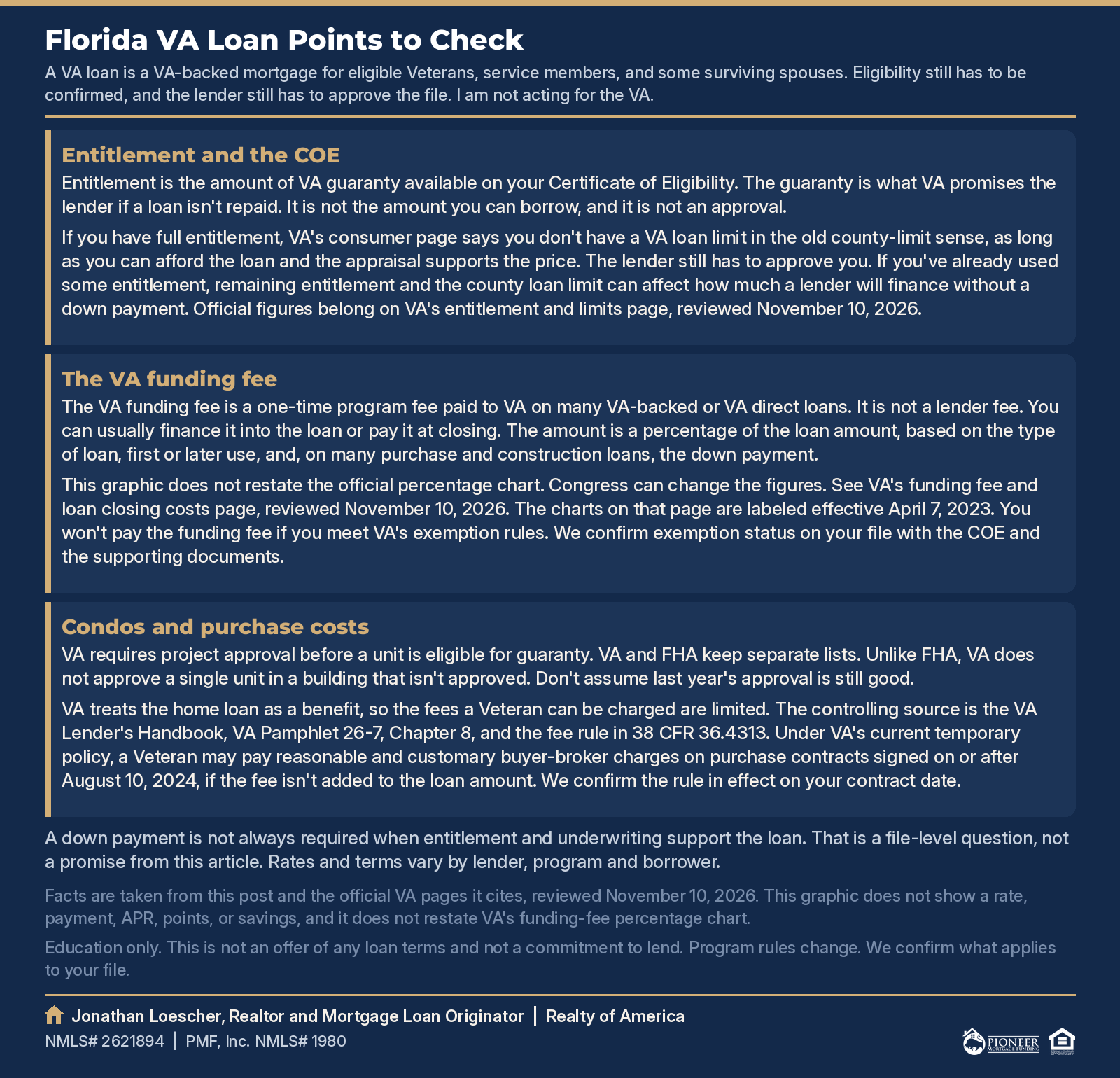
Entitlement is the amount of VA guaranty available on your Certificate of Eligibility, often called a COE. The guaranty is what VA promises the lender if a loan isn't repaid. It is not the amount you can borrow, and it is not an approval.
If you have full entitlement, VA's consumer page says you don't have a VA loan limit in the old county-limit sense, as long as you can afford the loan and the appraisal supports the price. The lender still has to approve you based on credit, income, debts, and assets. If you've already used some entitlement, such as when you still have a VA loan, remaining entitlement and the county loan limit can affect how much a lender will finance without a down payment. VA's official entitlement and limits page (reviewed November 10, 2026; the page was last updated August 12, 2025) walks through how remaining entitlement is figured. I run those official figures on your COE rather than restating sample amounts here.
A down payment is not always required when entitlement and underwriting support the loan. If remaining entitlement isn't enough for the loan amount you want, the lender may ask for a down payment. That's a file-level question, not a promise I can make from this article.
The VA funding fee, without a rate chart in this post
The VA funding fee is a one-time program fee paid to VA on many VA-backed or VA direct loans used to buy, build, improve, or repair a home, or to refinance. It is not a lender fee. You can usually finance it into the loan or pay it at closing. On a purchase or construction-to-permanent loan, VA's consumer page says you can finance the funding fee, but not the rest of the closing costs, into the loan amount (reviewed November 10, 2026; the page was last updated October 5, 2026).
The amount is a percentage of the loan amount. VA bases it on the type of loan, the loan amount, whether it is a first or later use of the benefit, and, on many purchase and construction loans, the down payment. I am not restating the percentage chart here. Congress can change the figures, and the official chart belongs on VA's site. See VA funding fee and loan closing costs, reviewed November 10, 2026. The charts on that page are labeled effective April 7, 2023.
You won't pay the funding fee if you meet VA's exemption rules. As of that same review date, VA's page says you are exempt if you are receiving VA compensation for a service-connected disability; if you are eligible for that compensation but receive retirement or active-duty pay instead; if you are a surviving spouse receiving Dependency and Indemnity Compensation; if you are a service member who has received a proposed or memorandum rating before closing on a pre-discharge claim; or if you are on active duty and, on or before closing, provide evidence that you received a Purple Heart. If you are later awarded compensation with an effective date before the closing, you may be able to request a refund. A proposed or memorandum rating issued after closing does not qualify you for a refund. We'll confirm exemption status on your file with the COE and the supporting documents.
VA loans on Florida condos
VA requires project approval before a unit is eligible for guaranty. VA and FHA keep separate lists. Unlike FHA, VA does not approve a single unit in a building that isn't approved. Don't assume last year's approval is still good. FHA project approvals have expiration dates, and a building's status on any list can change.
The full project-approval walkthrough, including how to check the lists and how conventional reviews changed in 2026, is in Can You Get a VA or FHA Loan on a Tampa Bay Condo? If the building is in Pinellas and you're also vetting reserves, inspections, or special assessments, start with vetting Pinellas condo reserves. I summarize the VA rule here so you know to check the building early. I don't repeat that deeper guide.
If the appraisal may come in below the contract price, see what VA Tidewater means. After the Notice of Value is issued, the Veteran can also ask VA in writing to reconsider the value. A VA purchase contract has to include VA's escape clause, which lets the veteran cancel without losing the earnest money deposit if the price is above VA's reasonable value, or choose to go forward anyway. The contract and its deadlines control the details, so review them with your Realtor and, if needed, a Florida real estate attorney.
What VA purchase costs can a buyer not pay?
VA treats the home loan as a benefit, so the fees a Veteran can be charged are limited. The controlling source is the VA Lender's Handbook, VA Pamphlet 26-7, Chapter 8, and the fee rule in 38 CFR 36.4313. Fees not expressly permitted may not be charged to or paid by the Veteran obtaining the loan (handbook Chapter 8, Topic 1; Chapter 8 reviewed from official handbook text November 10, 2026).
Chapter 8, Topic 3 lists costs the Veteran-borrower cannot pay. Those include attorney's fees charged by the lender (you may still hire your own attorney under a separate arrangement, and reasonable title examination and title insurance can be itemized). The handbook's list also includes real estate brokerage fees or commissions charged to the Veteran-purchaser. Since August 10, 2024, VA has allowed a temporary exception for buyer-broker charges, explained below. A Veteran obtaining a VA refinance cannot use loan proceeds to pay a prepayment penalty on an existing lien, and a Veteran buying with a VA loan cannot pay penalty costs required to discharge the seller's existing liens. In proposed construction that was built under HUD supervision, HUD or VA inspection and re-inspection costs in the cases the handbook describes must be borne by the builder or sponsor, not the Veteran-purchaser.
Buyer-broker commissions changed in 2024. VA Circular 26-24-14 lets a Veteran pay reasonable and customary buyer-broker charges on purchase contracts signed on or after August 10, 2024, where buyer-broker pay can no longer be set through the MLS or paid through the listing broker. Those charges can't be added to the loan amount, and the lender counts them when it checks whether you have enough cash to close. The seller can still agree to pay your buyer-broker's fee, and VA doesn't count that as a seller concession. The circular is a temporary policy that stays in effect until VA rescinds it, so we confirm the rule in effect on your contract date. Your written buyer agreement sets what your broker is paid, and that amount is negotiable.
What a VA buyer can pay, and what a seller can cover
Chapter 8, Topic 2 says the Veteran can pay reasonable and customary amounts for the itemized fees VA designates, plus a limited flat charge by the lender that is meant to cover the lender's own costs and services, plus reasonable discount points. The itemized list includes things like the VA appraisal (with limits on who may request a second appraisal), recording fees, a credit report, prepaid taxes and insurance deposits, required hazard or flood insurance, a third-party flood-zone determination, a survey if required, and title examination and title insurance. The funding fee is also on that list unless you are exempt. The handbook also lists items that cannot be broken out as separate itemized fees and instead have to be covered by the lender's flat charge, such as document-preparation fees, notary fees, postage, and loan-processing fees. I confirm the actual Closing Disclosure on your file rather than treating this as a fee quote.
Sellers and builders can pay some of the buyer's costs. VA's funding fee and closing costs page distinguishes ordinary credits toward loan closing costs from "seller's concessions," and it limits concessions. I'm not restating that cap here. Look at the official page, reviewed November 10, 2026, and we'll apply the current rule to the contract. For a broader cost walkthrough, see how much closing costs are in Florida and can the seller pay my closing costs.
How I'd look at a Florida VA file
I start with the COE, occupancy, and the property type. VA underwriting also looks at residual income, which is the money left each month after housing costs and other obligations, and you have to certify that you intend to live in the home. If it's a condo, I check project approval before we treat the unit as a VA candidate. I look at funding-fee exemption, remaining entitlement if you've used the benefit before, and the fee rules in Chapter 8 when we review credits and closing costs.
Ready to start? Apply for a mortgage or book a consultation.
As a Realtor with Realty of America, I can help you find the home. As a Mortgage Loan Originator with PMF, Inc., I can help with the loan. PMF, Inc. is a mortgage broker that works with many wholesale lenders, so I can compare options for your situation. Rates and terms vary by lender, program and borrower, and I can't promise any particular rate or approval. You can use one or both. You don't have to use both. I'm not acting for the VA.
Common questions
Does a VA loan in Florida work the same in every county?
The VA rules are federal. Property, condo approval, flood, insurance, and remaining entitlement can still vary by county and by building. The Pinellas FAQ is a short local answer. This guide is the broader Florida walkthrough.
Can I get a VA loan if I already used my benefit?
Sometimes, if you have remaining entitlement or you can restore entitlement, and if the lender approves the file. Remaining entitlement can change whether a down payment is needed. We'll read your COE rather than guess.
Where do I find the current funding fee?
On VA's official funding fee page. I point you there instead of copying the chart into this article, because the official figures can change.
Can I pay a buyer-broker fee on a VA purchase?
Yes, under VA's current temporary policy, if the fee is reasonable and customary and isn't added to the loan amount. The seller can also agree to pay it. Your buyer agreement sets the amount, and it's negotiable. We confirm the rule in effect on your contract date.
This article is for education only. It is not an offer of any loan terms and not a commitment to lend. Program rules change. We confirm what applies to your file.
Jonathan Loescher, Realtor, Florida real estate license SL3546365, Realty of America. Jonathan Loescher, Mortgage Loan Originator, NMLS 2621894. Mortgage loans are originated through PMF, Inc., NMLS 1980, a Florida licensed Mortgage Broker. Real estate and mortgage services are provided by separate companies, and you don't have to use both. Verify licensing at www.nmlsconsumeraccess.org. Equal Housing Opportunity.
Education only. This is not a commitment to lend. All loans are subject to credit approval, underwriting, and property eligibility. Not all applicants will qualify. Any loan approval is conditional until all underwriting conditions are met. Programs, rates, terms and conditions may change without notice.
Common questions
- What is the average mortgage rate in Florida today?
- I don't post averages here. Rates move often, and your rate depends on your credit, loan program, down payment, property type, occupancy, and lock period. A published average can be far from what you'd get. Ask for a quote on your own scenario, dated, with the program and terms. Any loan approval is conditional until all underwriting conditions are met.
- How often do mortgage rates change?
- Often. Pricing can change daily, sometimes more than once, as bond markets move. Your quote also changes if your credit, down payment, program, or property changes. That's why quotes are dated. A rate lock holds pricing for a set period once you're under contract. Any loan approval is conditional until all underwriting conditions are met.
- What is a rate lock?
- A rate lock holds your rate and pricing for a set number of days while your loan closes. If the market rises, your lock holds. If closing slips past it, an extension may cost extra. Longer locks can cost more. Changes to your file, like the price or credit, can reprice it. Any loan approval is conditional until all underwriting conditions are met.
- What is the difference between pre-approval and pre-qualification?
- Pre-qualification is a conversation about income and credit. Pre-approval is a lender review of a file. Apply on this site for a second look even if you already have a letter from somewhere else.
- What Florida mortgage loan programs can a Mortgage Loan Originator offer?
- Common programs include conventional, FHA, VA, cash-out refinance, and non-QM loans like bank statement and DSCR. Some pair with down payment assistance. The right one depends on your file. You don't have to use both companies. Any loan approval is conditional until all underwriting conditions are met.
More Tampa Bay home and loan answers on Ask Jonathan.
Enjoying this? Make us a preferred source on Google.