
Mortgage Guide
Non-QM for Investors: More Than a DSCR Loan
Investors sometimes use documentation other than a standard DSCR loan to finance a Tampa Bay rental. A DSCR loan is often the first path I look at when the property's rent should carry the payment. It is not the only Non-QM option, and it is not a fit for every rental. There may be a path, but not for every file.
For the definition of a DSCR loan, occupancy rules, and how I use it on a Florida rental, start with DSCR Loans in Florida and DSCR loan programs. This post is a companion. It does not replace that guide. For what a Non-QM loan is, see what a non-QM loan is.
What "Non-QM" means on an investor file
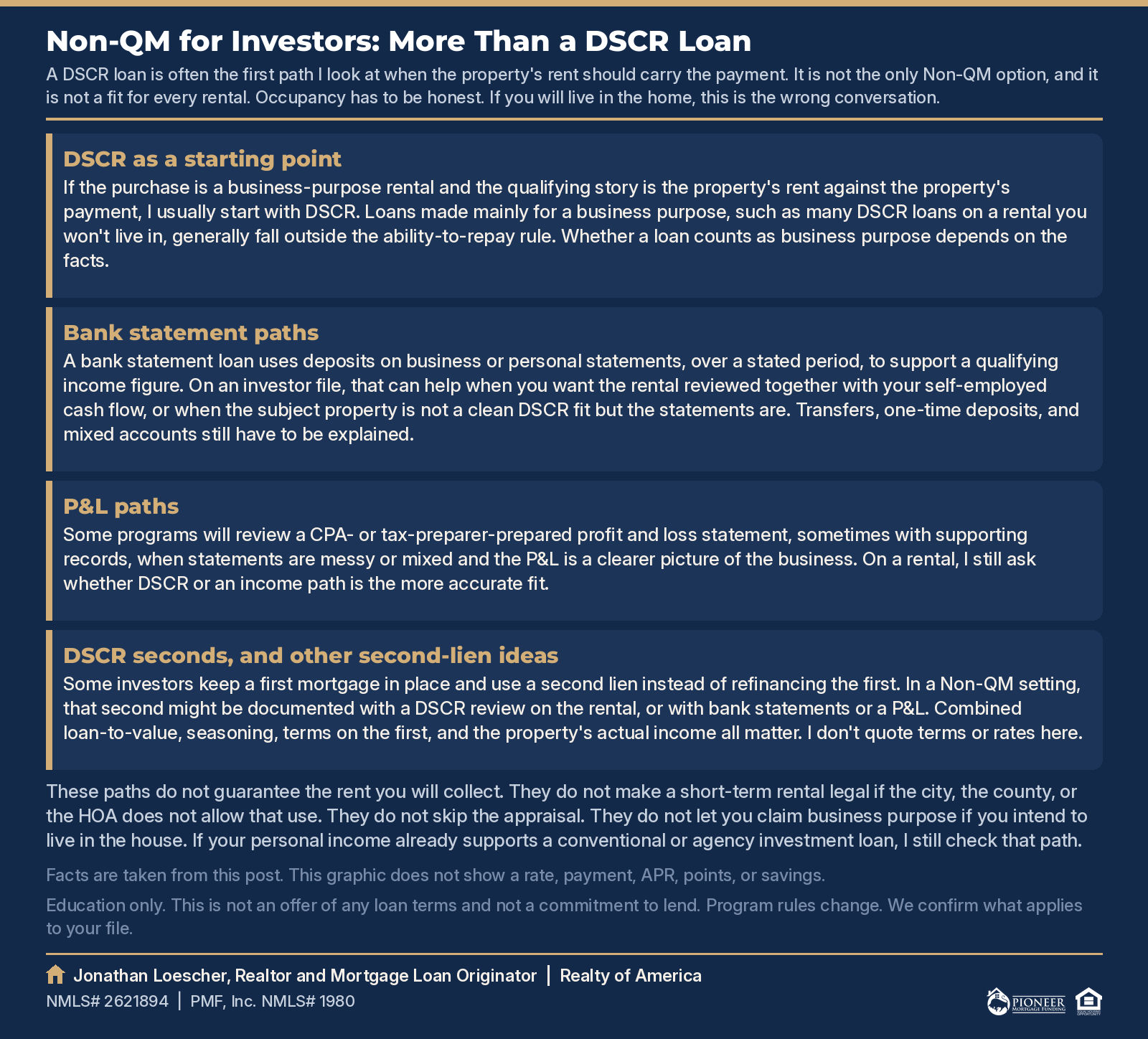
An investor loan like this is usually a Non-QM mortgage. That means it isn't a "qualified mortgage" under federal ability-to-repay rules, and it doesn't follow the documentation standards Fannie Mae and Freddie Mac use for a regular conventional loan. On a consumer-purpose loan, the lender still has to make a reasonable, good-faith determination, based on verified records, that you can repay. Loans made mainly for a business purpose, such as many DSCR loans on a rental you won't live in, generally fall outside the ability-to-repay rule. Whether a loan counts as business purpose depends on the facts, including whether you'll use the property yourself. Occupancy has to be honest. If you will live in the home, this is the wrong conversation.
When DSCR is still the starting point
If the purchase is a business-purpose rental and the qualifying story is the property's rent against the property's payment, I usually start with DSCR. I can originate DSCR loans through PMF, Inc., and I'll tell you whether a given property is even in range without quoting terms here. For tradeoffs, see DSCR loan pros and cons for Florida investors. For local use restrictions, see Tampa Bay short-term rental rules. For a numbers-only planning view after the loan question is clear, calculating ROI on a Tampa Bay investment property may help. None of those pages is a cash-flow guarantee, and neither is this one.
Bank statement paths on a rental
A bank statement loan uses deposits on business or personal statements, over a stated period, to support a qualifying income figure. On an investor file, that can help when you want the rental reviewed together with your self-employed cash flow, or when the subject property is not a clean DSCR fit but the statements are. It is still underwriting, not a copy of your deposits. Transfers, one-time deposits, and mixed accounts still have to be explained. I compare this path with DSCR rather than assuming one is better.
P&L paths on a rental
Some programs will review a CPA- or tax-preparer-prepared profit and loss statement, sometimes with supporting records, when statements are messy or mixed and the P&L is a clearer picture of the business. That is one documentation option among several. I compared P&L-only with bank statements, 1099, written verification of employment, full documentation, and asset paths in P&L-Only Loans and Other Self-Employed Mortgage Paths in Tampa Bay. On a rental, I still ask whether DSCR or an income path is the more accurate fit.
DSCR seconds, and other second-lien ideas
Some investors keep a first mortgage in place and use a second lien instead of refinancing the first. In a Non-QM setting, that second might be documented with a DSCR review on the rental, or with bank statements or a P&L. I can originate DSCR second liens through PMF, Inc. Availability and terms vary by lender and property. The use is often cash-out for another purchase, improvements, or reserves, or a way to avoid opening the first mortgage.
A second lien is not the same product as a cash-out refinance of the first. Combined loan-to-value, seasoning, terms on the first, and the property's actual income all matter. I don't quote terms or rates here. I'll tell you whether a second is even available on the file, and whether it is more sensible than refinancing the first.
What these investor paths do not do
They do not guarantee the rent you will collect. They do not make a short-term rental legal if the city, the county, or the HOA does not allow that use. They do not skip the appraisal or the property review. They do not let you claim business purpose if you intend to live in the house. They do not approve the loan or set a rate in this article. If your personal income already supports a conventional or agency investment loan, I still check that path, because it can be the simpler fit.
How I'd look at the file
I start with occupancy and the property, then with how you actually document income. I compare an agency investment path, a DSCR first, and, when it applies, a bank-statement, P&L, or second-lien path. Approvals stay conditional until underwriting is finished.
Apply for a mortgage and tell me it's a rental, or book a consultation if you want to talk first.
As a Realtor with Realty of America, I can help you find the property. As a Mortgage Loan Originator with PMF, Inc., I can help with the loan. PMF, Inc. is a mortgage broker that works with many wholesale lenders, so I can compare options for your situation. Rates and terms vary by lender, program and borrower, and I can't promise any particular rate or approval. You can use one or both. You don't have to use both.
Common questions
Is DSCR the only Non-QM loan for a rental?
No. Bank statement, P&L, and some second-lien options can also come up. DSCR is still the usual starting point when the rent is the qualifying story.
Can I use these paths on a home I will live in?
Not as a business-purpose rental loan. If you will occupy the property, we look at personal-income paths instead.
Do you handle DSCR files other than a plain long-term rental?
I can look at the DSCR situations I see in this market, including harder property or documentation questions, and I'll tell you whether a path is even on the table. I won't quote terms in this article.
This article is for education only. It is not an offer of any loan terms and not a commitment to lend. Program rules change. We confirm what applies to your file.
Jonathan Loescher, Realtor, Florida real estate license SL3546365, Realty of America. Jonathan Loescher, Mortgage Loan Originator, NMLS 2621894. Mortgage loans are originated through PMF, Inc., NMLS 1980, a Florida licensed Mortgage Broker. Real estate and mortgage services are provided by separate companies, and you don't have to use both. Verify licensing at www.nmlsconsumeraccess.org. Equal Housing Opportunity.
Education only. This is not a commitment to lend. All loans are subject to credit approval, underwriting, and property eligibility. Not all applicants will qualify. Any loan approval is conditional until all underwriting conditions are met. Programs, rates, terms and conditions may change without notice.
Common questions
- How does a DSCR loan help investors buy rentals in Tampa Bay?
- It qualifies a rental on its rent compared to the full payment, not your personal income. It's for business-purpose rentals only. Expect larger down payments and reserves. Check local rental rules first. Any loan approval is conditional until all underwriting conditions are met.
- What's the difference between a second home loan and an investment property loan?
- It depends on how you'll use the home. A second home is for your own use part of the year, and programs limit renting it. An investment property is bought to rent. Investment loans usually need a larger down payment and reserves and price higher. You certify occupancy at closing. Any loan approval is conditional until all underwriting conditions are met.
- How does a bank statement loan work for self-employed buyers in Tampa Bay?
- It uses deposits on your bank statements over many months, not tax returns, to figure income. It's a non-QM option for self-employed buyers whose returns understate cash flow. Expect larger down payments, reserves, and pricing that differs from conventional. Any loan approval is conditional until all underwriting conditions are met.
- Do I need a state license for a short-term rental in Florida?
- Yes, if you rent more than three times a year for stays under 30 days, or advertise it that way. You need a DBPR vacation rental license, either Condo or Dwelling, before you operate. Running without one is a second-degree misdemeanor. You'll also need tax registrations and any local permit your city or county requires.
- Can I do short-term rentals in Tampa?
- It depends on the zoning. A 2022 Tampa court decision upheld a violation for a two-night rental in a South Tampa RS-60 zone, reading the code to require weekly or longer stays there. Other zones may differ, and the code can change. Before you buy, check the parcel's zoning with the city, read any HOA or condo rules, and plan for the state license and taxes.
More Tampa Bay home and loan answers on Ask Jonathan.
Enjoying this? Make us a preferred source on Google.